


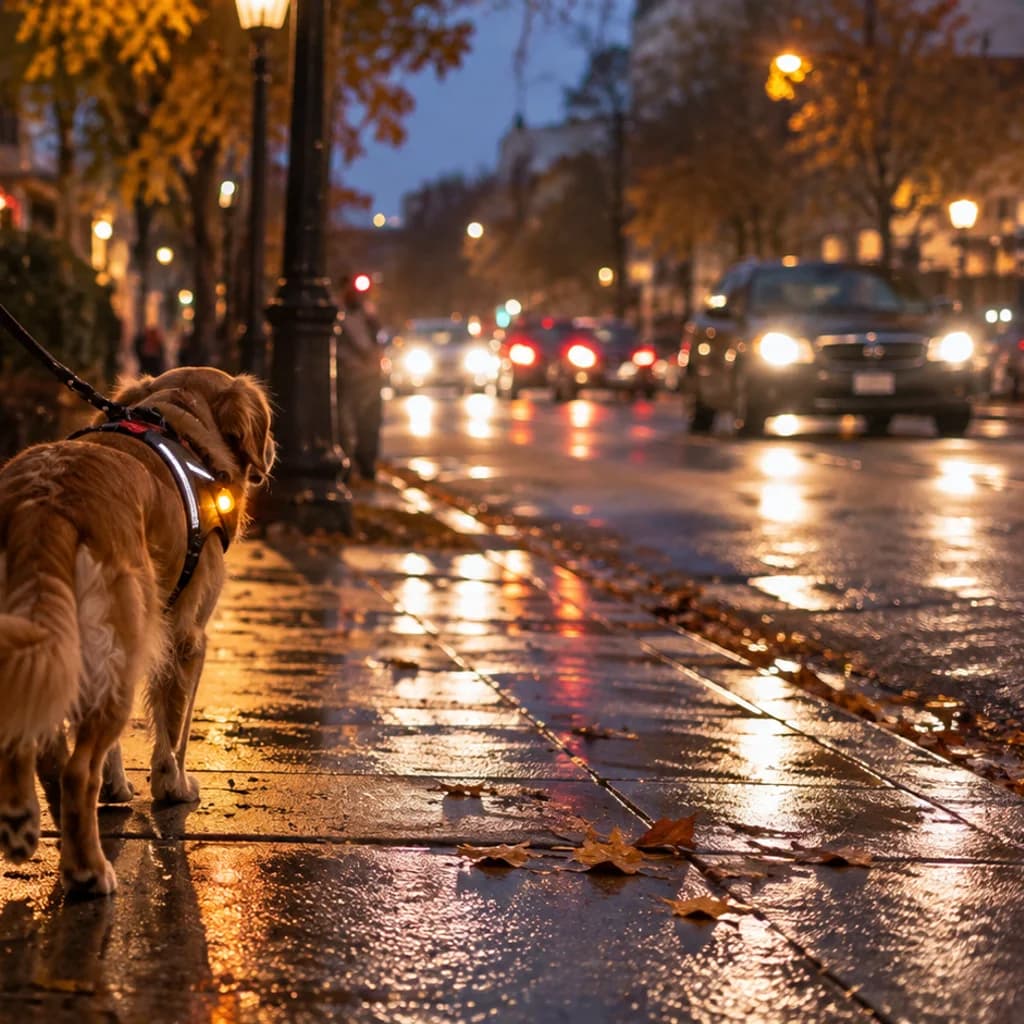

When the clocks go back, the evening walk suddenly turns into something you do in the dark. Same route, same time, but how far you can see has changed. Drivers notice the dog by the road and the person holding the leash later; the dog also sees different shadows and hears different sounds on a street it knows well.
This transition period is a stretch when accidents and escapes go up. The good news is that the fix isn't expensive gear but visibility, route and equipment checks. A few small changes turn dark evenings back into a normal routine.
You can work through the sections below in order. Instead of changing everything on the same evening, sort out visibility first, then review your route.
When does a driver see you?
In the dark, a person in a dark coat and a dog with black fur are nearly invisible until they enter the headlight beam. The gap between headlight range and a car's stopping distance is narrow even at city speeds. So being more visible actually gives the driver, not the pedestrian, more time to decide.
There are two different technologies, and you need both:
- Reflector: Bounces light back when light hits it. It does nothing where there are no headlights, but it does the job in traffic.
- Light-up gear: Makes its own light. It keeps you visible even without headlights, but stops working when the battery runs out.
Color choice also makes a difference. A dark-coated dog blends into the ground at night, while a light-colored or bright harness helps make out its shape. The goal isn't to make the dog eye-catching; it's to help the driver realize early that a living creature is moving at the roadside.
While you put a reflective collar and harness on your dog, add something for yourself too. The first thing a driver sees is usually the person; when the two move together, the picture becomes clear.
Choosing and checking equipment
Light-up leashes and collar attachments are cheap and effective. When choosing, look for these:
- The light source shouldn't be in the dog's eyes; models that sit under the collar or on the back of the harness are more comfortable.
- With rechargeable models, check the battery once a week. A light that goes out halfway through a walk might as well not be there.
- Reflective strips lose their reflectivity as they're washed and wear down; look them over at the start of the season.
- If you prefer a harness, check the buckles by hand in the dark. Putting it on in a winter coat and gloves isn't as precise as it is in daylight.
The most common thing that happens in the dark is a dog slipping out of a harness whose buckle wasn't fully clicked in. Tug on the buckle before you head out, and hold the leash firmly in your palm instead of wrapping it around your wrist. Retractable leashes make it harder to control distance in the dark, so a fixed-length leash is easier on routes near traffic.
An ID tag also becomes more important in this period. A tag with a current phone number can get a dog that has run off back home the same night. To check that the microchip registration is up to date, you can ask your vet; you can find clinics near you in the vet directory.
Rethink your route
A route that's easy in summer isn't the same route in the dark. When planning your evening walk, go over these points:
- Choose streets where the lighting works. Reporting burned-out streetlights to the municipality takes a few minutes.
- Avoid connecting roads with no sidewalk and fast traffic.
- Cross the street at well-lit spots with a wide view.
- If you can't see uneven ground on park paths, shift your route to the lit road around the park.
- When walking on the sidewalk, keep the dog on the wall side, not the road side.
Walking the route once in daylight works better than trying it for the first time in the dark. A pothole, a loose drain cover or a construction entrance you didn't notice by day can cause trouble at night. Likewise, if there are spots along the route with unleashed dogs, knowing them in advance eases the tension.
Changing the route won't take away from your dog's fun; as long as you give it time to sniff, a short, well-lit loop is satisfying enough. Instead of going farther in the dark, letting it stop and sniff strikes a practical balance.
Your dog's behavior in the dark
Some dogs are more uneasy in the dark. Shadows, sudden lights and sounds that seem louder in the quiet lower their threshold for reacting. In senior dogs, declining eyesight may be noticed for the first time during this period: if you see signs like hesitating on a familiar path, bumping into curbs or not wanting to walk, talk to your vet about an eye check.
With a startled dog, the riskiest moment is when it backs away. The chance of slipping out of a neck collar is higher than with a harness, so a harness is the safer choice on routes near traffic. At spots where it reacts, increasing the distance and waiting for it to calm down works faster than pulling it along.
Fireworks, car alarms or a loud door slam hit harder in the dark. If you live in a neighborhood where these sounds are common, shifting your walk time is a simple fix. If its reaction is severe and repeats every time you go out, you might consider getting help with behavior.
With a newly adopted dog, start your first dark walks short. Exercise needs and tendency to react vary by breed; you can look into the details in the Pet Encyclopedia.
The first minutes if your dog runs off
If the leash slips out of your hand, chasing after the dog often drives it farther away. In the dark this is even harder, because you can't see as far.
- Remember the last spot where you saw it and the time, and mark it on your phone if you can.
- Crouch down, turn your body to the side and calmly use your familiar recall word.
- Don't walk toward it; back away to encourage it to come to you.
- If someone is with you, have them stay at that last spot while you check nearby exits.
- If you can't find it quickly, post a listing in the lost pets section; location and time details narrow the search area.
Once the dog is found, don't continue the walk. Check the equipment, and if there's an injury or heavy panting, head home and contact your vet if needed.
A quick check after the walk
Things you couldn't see in the dark show up once you're home. Check the paws as soon as you walk in: broken glass, gravel, caked mud or cuts are the most common finds. In dogs that walk on wet, cold ground, the skin between the toes can get irritated.
Salt and de-icers spread on sidewalks in winter are on this list too. Residue left on the paws can cause digestive upset when licked, so rinsing with lukewarm water and drying is a simple but effective step. If irritation, limping or constant licking continues, talk to your vet.
Look over the leash, harness and light gear at the same time. A worn seam, a loose buckle or a weak battery gets noticed before it becomes the next evening's problem.
Frequently Asked Questions
Is a light-up collar enough on its own?
On routes with traffic, it's safer to use it together with a reflector. The light gets you noticed from a distance, and the reflector clearly shows your position in the headlights.
My dog doesn't want to walk in the dark. What should I do?
Start with health: eyesight, joint pain or ear problems can lead to similar behavior. If the vet check turns up nothing, move your route to well-lit streets, shorten the distance and go at its pace without forcing it.
Is early morning a better time than evening?
Mornings can be dark too, so the same precautions apply. The difference is traffic; cars usually go faster in the morning, so don't skip the visibility gear.
Do I need a reflective vest?
It's not required, but light-colored, reflective outerwear increases the distance at which a driver can see you. A reflective band you can attach to your current coat is also a useful start.









