


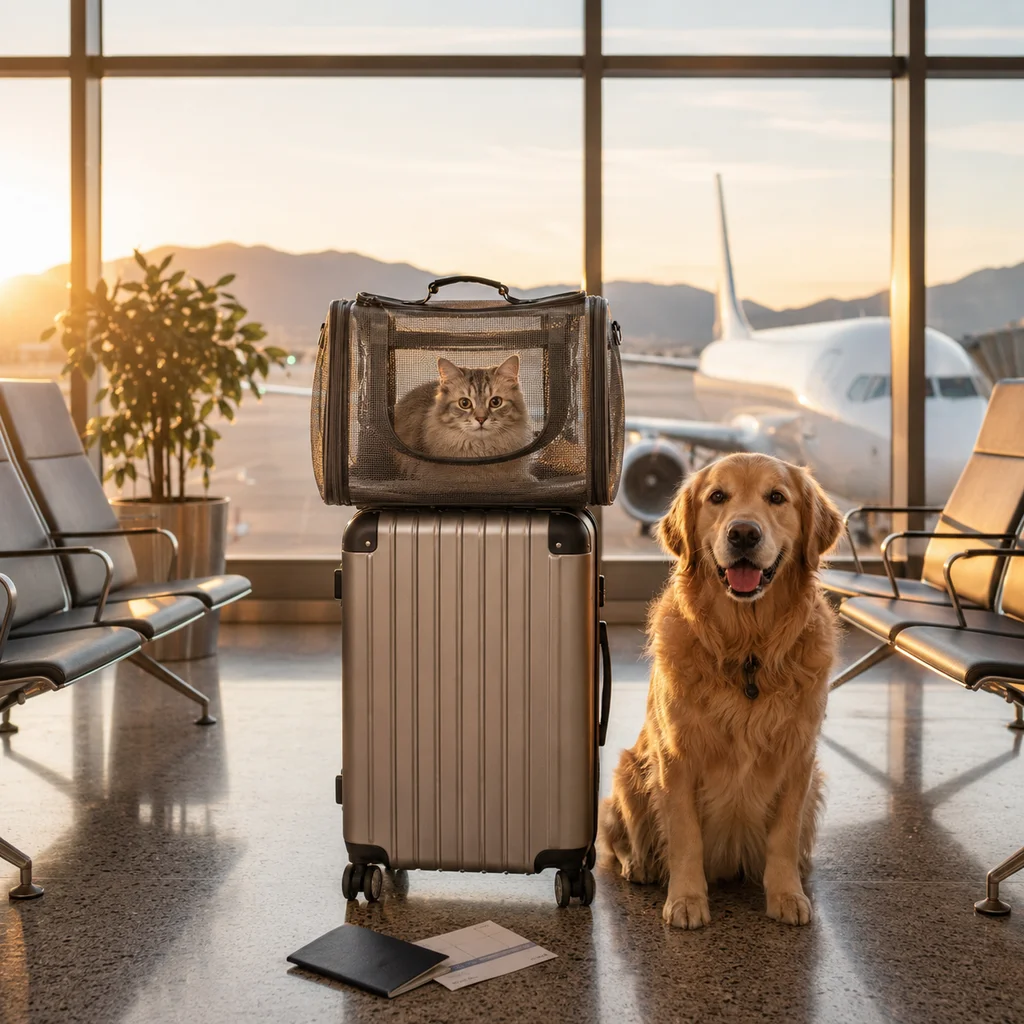

Traveling abroad with your pet is a completely manageable process when it is planned well. But people who say "I'll get ready the last week" often hit a surprise obstacle on the day of the flight: a missing vaccine, a microchip done in the wrong order, an approval date that is no longer valid. This guide walks you through, in order, the steps you need to travel with your furry friend to Europe, the US, the UK or faraway countries.
Important note: Every country's rules can change over time. This guide summarizes the general principles; before your flight, always take one last look at the announcements from the Ministry of Agriculture and Forestry: Animal Health and at the destination country's official pet travel page.
1. Before You Go: A Realistic Timeline
For most countries there are steps you need to start 21 days ahead, and for some, 3 months ahead. The calendar below is for an average trip to Europe; for countries with quarantine (such as Australia, New Zealand and Japan), you need to start planning 6 months in advance.
- T-6 months: Settle on the destination country and read its official pet travel page all the way through. Catch surprise requirements such as quarantine, titer tests or banned breeds early.
- T-4 months: Microchip check. If your pet doesn't have one, have your vet implant an ISO 11784/11785 standard chip. The microchip must be implanted before the rabies vaccine.
- T-3 months: Rabies vaccine (if it hasn't been given or its validity is running out). If needed, a blood sample is taken for the rabies antibody titer test (FAVN); results can take 1-2 months.
- T-30 days: Airline booking plus pet approval. Don't buy a flight without approval, because cabin and cargo spots are limited.
- T-10 days: Vet exam and the start of the international health certificate. This is where the approval chain with your city or district agriculture directorate begins.
- T-7 days: Stamp and signature from the city or district agriculture directorate. For most countries this approval must be done no more than 10 days before the flight; don't miss the date window.
- T-48 hours: Final health check, one last check of the carrier, full printouts of the documents and PDF copies. Do not give your pet a sedative: airlines prohibit it.
2. Required Documents and Health Requirements
Technically, this is the most critical part of the process. A single date error can ruin the whole plan.
Microchip: The Order Is Vital
The internationally valid microchip standard is ISO 11784/11785. For animals with chips that don't meet this standard, some countries can't scan them with their own readers; in that case you may need to carry your own portable reader.
The microchip must be implanted before the rabies vaccine. Otherwise, the vaccine date is counted from the date the microchip was implanted, and you will most likely need to vaccinate again. Always ask your vet for the chip number in a written document, and also save it in DoldurKabı Pet Health Tracking so you can reach it with one tap on the day of your flight.
Rabies Vaccine and Titer Test
The general rule: the rabies vaccine must be valid (usually for 1 year), given after the microchip, and at least 21 days must have passed since the vaccination. This basic rule applies to most countries, including the US, the EU and the United Kingdom.
For departures from countries like Türkiye, EU countries and the UK may also require a rabies antibody titer test (FAVN). The result must be 0.5 IU/ml or higher, and there is usually a 3-month waiting period after the titer test. This is not a test you can "do a week before"; early planning is a must.
Veterinary Health Certificate and Directorate Approval
The international veterinary health certificate issued for your pet when leaving Türkiye must be in the format accepted by the destination country (for example, a form compatible with the TRACES NT system for EU countries). This certificate:
- Is completed by your vet after an exam,
- Is stamped and approved by your Provincial or District Directorate of Agriculture and Forestry,
- Must be approved no more than 10 days before the flight date (depending on the country, it can also be 5 or 4 days).
Carry the approval document both as a PDF and on paper; some checks ask for a physical signature and stamp.
Getting the Facts Right About the "Pet Passport"
The "EU Pet Passport" is issued only in EU member countries, by that country's authorized vets; it is not issued in Türkiye. When leaving Türkiye, you travel with the Veterinary Health Certificate described above, plus the directorate approval, the rabies vaccination record and (if required) the titer test result. After living in the EU for a while, you can get a pet passport issued there and use it when you return to Türkiye.
3. General Requirements by Country
Always check the official source for details. Below are only the basic differences.
European Union Countries
Microchip, a valid rabies vaccine, a titer test (for those coming from "unlisted" countries such as Türkiye) and a health certificate. Entry is usually allowed only through approved entry points (Travelers' Point of Entry); some small airports don't accept pets. Official page: European Commission: Movement of Pets.
United Kingdom
After Brexit, the UK has its own system. Microchip, rabies vaccine, titer test (from unlisted countries such as Türkiye) and a health certificate. For flights from some countries, entry is accepted only with approved carriers and on approved routes. Official: gov.uk: Bring a pet to Great Britain.
United States
Since August 1, 2024, new CDC rules apply to dogs entering the US: the dog must be at least 6 months old, have an ISO microchip and a valid rabies vaccine, and the CDC Dog Import Form must be filled out. Dogs from certain countries have an additional titer test or serum requirement. For cats, the CDC side is relatively more flexible, but state rules can vary. Official: CDC Dog Importation.
Countries with Quarantine
Australia, New Zealand, Japan, Singapore, South Korea and the United Arab Emirates strictly apply a registration and quarantine process. Quarantine can last anywhere from 10 days to 6 months; applications usually start 6 months in advance. These countries aren't suited to "taking a pet on vacation"; they are for a planned relocation.
4. Your Pet on the Flight: Cabin or Cargo?
Your pet's size and the airline's policy decide between cabin and cargo.
Cabin (In-Cabin)
- Total weight (pet plus carrier) is usually limited to 8 kg, and to 10 kg on some airlines.
- The carrier must be small enough to fit under the seat (get the airline's measurements in advance).
- Flat-faced breeds (bulldog, pug, Persian, Himalayan) are restricted on most airlines, in both cabin and cargo, because narrowed airways can be fatal under pressure.
- Pet approval is required when you book; spots are limited (usually 2-4 pets per plane).
Cargo (Live Cargo)
- The only option for large dogs. The animal travels in a pressurized, temperature-controlled live cargo hold.
- Hot weather: some airlines don't accept live cargo on certain routes during the summer months (heat risk).
- The carrier must meet the IATA Live Animal Regulations: rigid plastic, ventilation on 3 sides, a lock, a water bowl and a feeding instructions label.
Popular Airlines from Türkiye
Turkish Airlines, Pegasus and SunExpress generally accept pets; cabin and cargo fees, breed restrictions and seasonal rules vary. Before buying a ticket, always read the airline's pet policy page and get booking approval. You can't board with a pet without approval.
5. Keeping Stress to a Minimum During Travel
- Getting used to the carrier: At least 2-3 weeks before the flight, put the carrier in your home with a blanket and treats inside. Your pet should see the carrier as a "safe space," not a "danger."
- Food: A light meal 4-6 hours before the flight. A full stomach plus pressure changes equals nausea.
- No sedatives: Airlines clearly prohibit them. Under cabin pressure they have a negative effect on breathing and circulation. Choose a natural calming spray recommended by your vet, a pheromone collar or reward-based exercises instead.
- Water: Put frozen ice cubes in the carrier; they melt during the flight and become water. Liquid water spills in turbulence.
- A familiar scent: A T-shirt or blanket that smells like you noticeably reduces your pet's stress.
6. Notes on Road and Sea Travel
If you are driving to Europe, the exact same documents are checked at the Schengen border (microchip, rabies vaccine and health certificate). Schengen border officers may have a microchip reader; don't guess, and carry your chip number in writing with you.
When traveling by ferry (routes to Greece and Italy), the ferry company's pet policy is separate from the airline's. On some ships pets travel inside the vehicle, on others in a special pet cabin. When booking, ask for a "pet-approved cabin".
7. Banned Breeds and Restrictions
Türkiye regulates the entry into the country and the ownership of certain breeds under Law No. 5199 and Law No. 7332. In general, there are restrictions on breeds such as the Pit Bull Terrier, Dogo Argentino, Fila Brasileiro, Japanese Tosa and American Staffordshire Terrier entering and leaving Türkiye. The destination country may also apply its own additional list.
Beyond that, "brachycephalic" (flat-faced) breeds such as the Bulldog, Pug, Persian cat and Himalayan are subject to flight restrictions. If your breed is on this list, get written approval from the airline before booking.
8. Arrival: What to Do in the First 48 Hours
- At customs, follow the animal/pet control signs and keep your document bag on top. Wait to be called before taking your pet out of the carrier.
- On the first night, let your pet sleep with familiar items (a blanket, a toy).
- Adjusting to the new time zone takes 1-3 days; don't go on long walks on the first day.
- Within 48 hours, plan a "well-arrived" exam with a vet in the destination country to check how your pet is adjusting to the new climate and food.
9. Returning to Türkiye
When returning to Türkiye from abroad:
- The same microchip and up-to-date rabies vaccination records,
- An international health certificate from an authorized vet in the country you are in,
- If you are returning from an EU country, the EU pet passport may be enough,
- An entry check at customs under the Animal Health and Inspection Law No. 3285.
10. 10 Common Mistakes
- The microchip was implanted after the rabies vaccine: the vaccine date resets and you can't enter the country.
- The city or district agriculture directorate approval was skipped: the certificate is invalid.
- The document date falls outside the 10-day window.
- A titer test was required but not done (because the destination country's list wasn't checked).
- Buying a cabin ticket for a large dog (when cargo is required).
- A ticket for a flat-faced breed without approval: it gets rejected before the flight.
- The carrier doesn't meet the IATA standard: it isn't accepted at the gate.
- The pet was given a sedative: it isn't accepted for the flight during the check.
- Trying to travel with a banned breed.
- Not planning the return (the same chain is needed again on the way back).
11. Frequently Asked Questions
Is a pet passport issued in Türkiye?
The EU Pet Passport is issued only by authorized vets in EU member countries. When leaving Türkiye, a "Veterinary Health Certificate plus directorate approval" is used.
Do the same rules apply to cats?
The general principles are the same: microchip, rabies vaccine, health certificate. The additional US dog importation rules from 2024 onward don't apply to cats; check each country's cat policy separately.
Can I give my pet a sedative?
No. Airlines clearly prohibit it and won't accept it. Sedatives increase breathing and circulation risks under cabin pressure. Choose pheromone sprays recommended by your vet, getting-used-to exercises and a familiar scent instead.
Can I travel with my puppy or kitten?
The general rule: the pet must be at least 12 weeks old for the rabies vaccine, and at least 21 days must have passed after the vaccine, so the earliest in theory is about 15 weeks. The US CDC requires dogs to be 6 months old. Practical advice: unless you have to, don't plan international travel while your pet is still young.
What happens if the microchip can't be scanned?
The process can continue with backup documents (previous scan records, a written report from the vet, photo identification); at the very least, carrying a portable microchip reader speeds things up a lot. That's why you should always have the chip tested before leaving Türkiye.
Which airline is the most suitable?
Because fees and policies change all the time, no single recommendation can be given. All major airlines have a pet policy page; before booking, get written approval on both price and breed eligibility.
What if my pet is stressed before the trip?
Getting your pet used to the carrier, short "practice trips" (30 minutes by car), familiar items and a general health and behavior check in advance with a vet near you noticeably reduce stress.
Final Word: Keep Your Documents Digitally, Too
The most common drama on flight day is an ordinary accident, like losing the physical documents or spilling coffee on them. If you keep the microchip number, vaccine dates, lab results and photos of the travel certificate in a digital archive in DoldurKabı Pet Health Tracking, your phone screen can save the day at the checkpoint.
Safe travels and have a great trip. This guide is for informational purposes; before every flight, confirm the current rules on the destination country's official pet travel page and in the announcements of the Ministry of Agriculture and Forestry. When you set out, the trip is worth turning into a memory you'll laugh about years later.









