


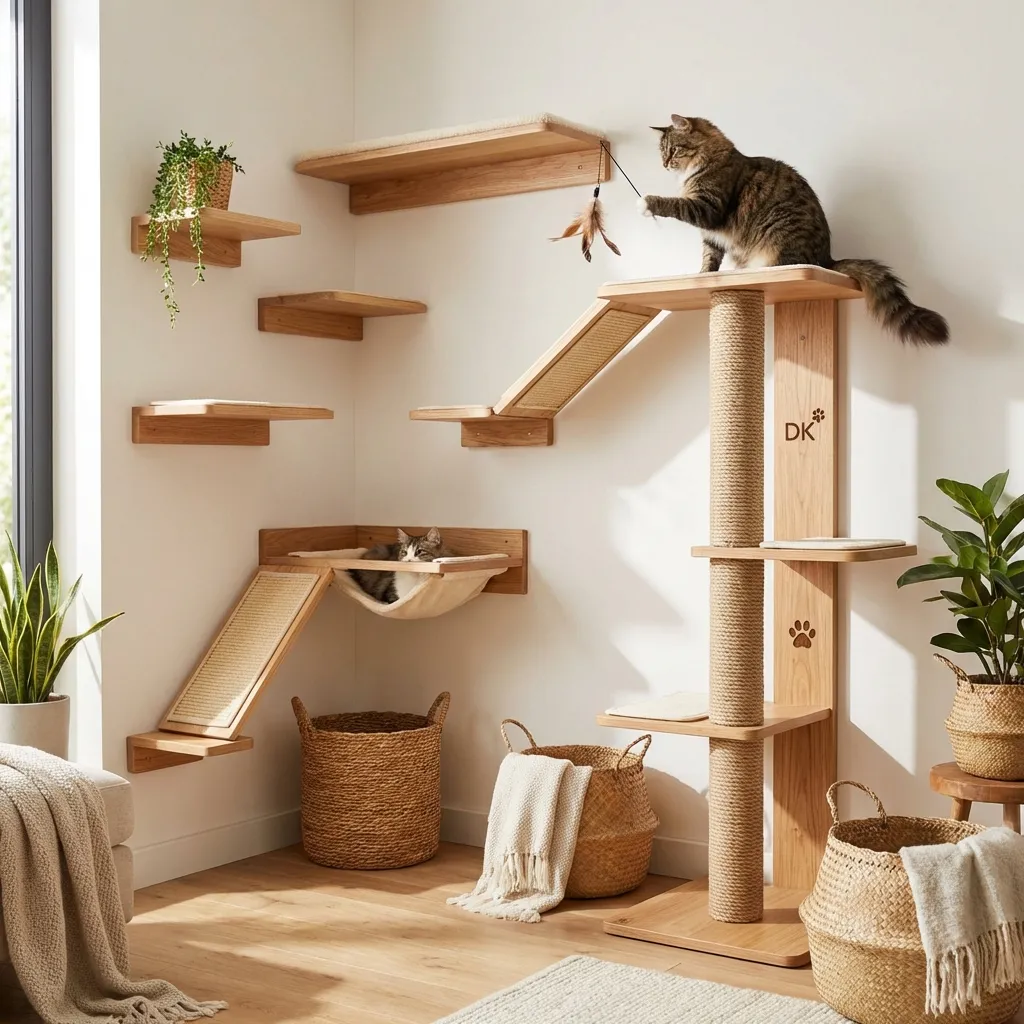

A Homemade Play Area for Your Cat: Budget-Friendly DIY Projects
By nature, cats have an instinct to climb, scratch, hunt and explore. Indoor cats, especially those living in apartments, can end up bored, stressed or dealing with behavior problems because they have no place to act out these natural behaviors. Instead of buying expensive cat trees and play sets, you can build your cat a wonderful living space with DIY projects that are easy to make at home.
Why Do Cats Need Vertical Space?
In nature, cats climb trees, watch their surroundings from high spots and track prey from above. This instinct carries on at home too. Access to high spots gives cats:
- A sense of safety: Being up high gives cats a feeling of control and lowers stress
- Territory control: In homes with more than one cat, vertical space cuts down on territory fights
- Exercise: Climbing and jumping keep cats physically fit
- Mental stimulation: Moving between different levels supports a cat's mental health
- A lookout point: Windowsills and high shelves let cats watch the outside world
Project 1: A Cat Path with Wall Shelves
Materials You Need
- 3-5 sturdy wooden shelves (30x20 cm or 40x25 cm)
- L-shaped metal shelf brackets (2 per shelf)
- Wall anchors and screws
- Adhesive carpet or felt (for the shelf tops)
- A drill and a spirit level
Steps
- Draw a plan: Mark where the shelves will go on the wall. So your cat can jump comfortably from one shelf to the next, leave 30-45 cm of vertical and 40-60 cm of horizontal space between shelves.
- Prepare the shelves: Glue adhesive carpet or felt onto the wooden shelves. This keeps your cat's paws from slipping and gives the claws something to grip.
- Mount the brackets: Using a spirit level, anchor the brackets to the wall. Make sure each bracket is held by at least 2 anchors. A cat usually weighs 3-7 kg, but the force when jumping can be 3-4 times that.
- Attach the shelves: Screw the shelves onto the brackets.
- Test them: Before letting your cat up, press on the shelves with your hand to check that they are solid.
Tip: Place the start of the shelf path at a height your cat can easily jump to (couch or coffee table level). End it at a windowsill or at your cat's favorite lookout spot.
Project 2: A Sisal Rope Scratching Board
Scratching is a behavior cats cannot do without. They use it to sharpen their claws, stretch their muscles, release stress and mark territory. If you do not provide a suitable scratching surface, your furniture will pay the price.
Materials You Need
- 1 wooden board (15x60 cm or 20x80 cm)
- Sisal rope (6-8 mm thick, about 20-30 meters)
- A hot glue gun or wood glue
- Small nails or a staple gun
- A wall hanger or L bracket (for wall mounting)
Steps
- Prepare the board: Sand the wooden surface smooth with sandpaper.
- Start the rope: Fix one end of the sisal rope to the bottom edge of the board with a staple or nail. Put a few drops of glue at the starting point.
- Start wrapping: Wrap the rope tightly around the board. Apply glue after every 4-5 wraps. Make sure no gaps are left between the wraps.
- Finish: Fix the last end of the rope with a nail or staple again and add glue.
- Mount it: Mount it on the wall at a slight angle (15-20 degrees) or stand it upright on the floor.
Budget saver: Pieces cut from old rugs also work as a scratching surface. Staple the rug onto the board and you have an inexpensive scratching board.
Project 3: A Cardboard Box Maze
Cats love boxes! You can join a few cardboard boxes to make a fun maze.
Materials You Need
- 4-6 large cardboard boxes (shipping boxes are ideal)
- A box cutter or scissors
- Wide tape
- Cat toys and catnip
Steps
- Prepare the boxes: Leave the box flaps open or cut them off.
- Cut passage holes: Cut holes in the sides of each box big enough for your cat to pass through easily (20x20 cm). Cover the edges with tape to hide any sharp edges.
- Join the boxes: Place the boxes side by side and on top of each other and tape them together. Create passages on different levels.
- Add hidden compartments: Put small boxes inside some of the boxes to create hidden compartments. Put toys or catnip inside.
- Peepholes: Cut small round holes in the tops of the boxes. Cats love watching the outside through these holes.
Tip: Rearrange the maze every few weeks to keep your cat curious. The biggest advantage of a cardboard box maze is that it is easy to replace once it wears out.
Project 4: A Window Perch
Cats can watch the outside through a window for hours. A window perch gives your cat a comfortable lookout point.
Materials You Need
- 1 sturdy wooden board (as wide as the window, 25-30 cm deep)
- 2 strong L brackets or chain shelf hangers
- A soft cushion or blanket
- Wall anchors and screws
Steps
- Find a suitable spot just below or next to the windowsill.
- Mount the L brackets firmly on the wall. Test them with 3 times your cat's weight.
- Screw the wooden board onto the brackets.
- Place a soft cushion or blanket on top.
- If you can leave the window partly open, fit a safety net or a screen.
Project 5: A Puzzle Feeder
Puzzle feeders satisfy a cat's hunting instinct and turn eating into a mental activity. They slow down fast eating and ease boredom.
Simple Puzzle Feeder: The Toilet Paper Roll Version
- Collect 5-6 empty toilet paper rolls.
- Fold one end of each roll closed.
- Put a few pieces of dry food or treats inside.
- Fold the other end too, or leave it half open.
- Place the rolls in a box or tray.
- Your cat will have to work with its paws to get the food out of the rolls.
Intermediate: A Plastic Bottle Feeder
- Cut 3-4 holes the size of a piece of dry food in the body of a clean plastic bottle.
- Smooth the edges of the holes with a flame or sandpaper.
- Put dry food inside and close the cap.
- As your cat rolls the bottle, food will drop out of the holes.
Project 6: A Cat Hammock
Materials You Need
- A sturdy piece of fabric (canvas or linen, 50x40 cm)
- 4 strong hooks or eye screws
- Rope or chain (4 pieces of equal length)
- Carabiners or S hooks
Steps
- Sew metal rings onto the four corners of the fabric, or punch holes and thread rope through them.
- Mount 4 hooks on the ceiling or between two walls.
- Tie the ropes to the hooks to hang the hammock. Set the hammock at a height your cat can easily jump to.
- Put a soft blanket on the hammock.
- Test its strength before putting your cat in it.
Safety Warnings
With DIY projects, safety should always come first:
- Solid mounting: Use proper anchors for every wall mount. For drywall, choose special drywall anchors.
- Sharp edges: Sand down or tape over wood, metal and cardboard edges.
- Toxic materials: If you use paint, varnish or glue, choose non-toxic products that are safe for your cat. This matters a lot because cats lick surfaces.
- Small parts: Small parts that could be swallowed (screws, anchors, nails) should be mounted securely where your cat cannot reach them.
- Sisal rope: Use natural sisal rope instead of synthetic rope. Synthetic rope can cause digestive problems if swallowed.
- Weight test: Before putting your cat on any project, test it with at least 3 times your cat's weight.
- Window safety: When making a window perch, always use a screen or a safety net. Cats are at risk of falling from heights (high-rise syndrome).
Why Do Scratching Surfaces Matter So Much?
For cats, scratching is not just a habit. It is a basic need:
- Claw care: Scratching sheds the old outer layers of the claws and keeps the claws healthy
- Muscle stretching: While scratching, cats stretch their front leg, shoulder and back muscles
- Territory marking: Cats mark territory with the scent glands under their paws
- Stress relief: Scratching is a stress-relieving activity for cats
Every cat has its own scratching preference. Some prefer vertical surfaces (a scratching post), others prefer horizontal surfaces (a scratching board). Watch your cat to learn its preference and provide the right scratching surface.
Budget-Friendly Tips
- Recycling: Make use of old shelves, boxes and fabric
- Buying in bulk: Buying sisal rope in bulk lowers the unit cost considerably
- Secondhand: You can find affordable wood and shelves on secondhand furniture sites
- Natural materials: Tree branches (cleaned and dried), pieces of rope and natural stones are free sources of material
- Building step by step: You do not have to do every project at once. Add one project each month and enrich your cat's living space gradually
The effort and time you put in for your cat will come back to you many times over in its happiness and health. Remember, for cats the most valuable thing is not the most expensive toy but the time and attention their owner gives them!









