


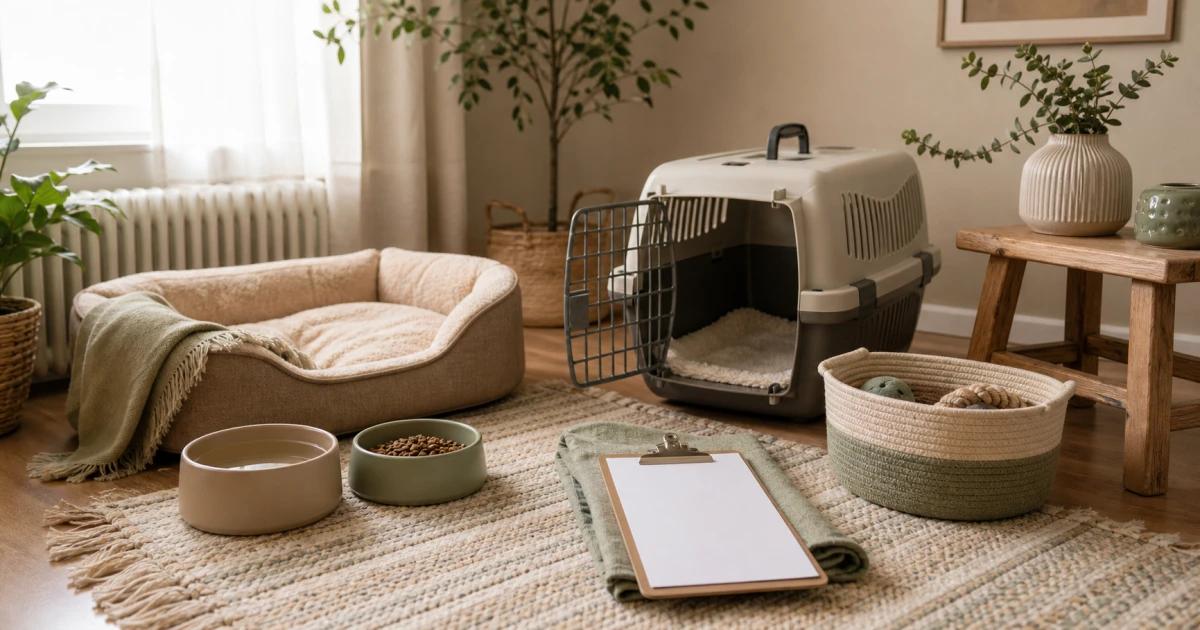

When your first pet comes home, trying to teach everything on day one can wear out both of you. The goal of the first month is not perfect behavior. It is a safe space, a predictable routine, a health record and learning each other's signals. Move through the steps slowly, keeping differences in species and personality in mind.
Before you start, take a photo of your current setup and spend a day observing. Instead of just following a list in theory, you will see which areas your pet actually uses and how things change through the day. If you need more context on choosing a species or on basic needs, finding a pet that fits your lifestyle is a good place to start.
This guide breaks setup into small steps you can check. After each step, watch appetite, movement, rest and how clean the space stays. Changing many things at once makes it hard to tell which detail helped or caused a problem.
Before your pet comes home
Remove cables, open windows, toxic plants, tight gaps and small items that could be swallowed from the living area. Prepare the basic gear for feeding, potty, sleep, transport and emergencies. Save nearby options for routine and emergency vet care, and do not leave your transport plan to the last minute. Adapt each step to your pet's age, species, health and living space. If you see discomfort, fear or unusual behavior, stop pushing; check for an environmental cause, and get a vet's opinion if there are any health signs.
- Remove cables, open windows, toxic plants, tight gaps and small items that could be swallowed from the living area.
- Prepare the basic gear for feeding, potty, sleep, transport and emergencies.
- Save nearby options for routine and emergency vet care, and do not leave your transport plan to the last minute.
In this stage, it is safer to make one change and watch the result than to change everything at once. For this first month with your first pet, keep short notes on the supplies you use, the date and any change you notice. That way, if a problem comes up, you know which step to undo, and you keep the daily routine the same for everyone at home.
Week one: keep the space small
Give your pet a calm starter zone and keep visitor traffic low. Start the food, water and potty setup as close to the previous routine as you can. Let your pet hide; do not force contact, cuddles or a tour of the whole house. Adapt each step to your pet's age, species, health and living space. If you see discomfort, fear or unusual behavior, stop pushing; check for an environmental cause, and get a vet's opinion if there are any health signs.
- Give your pet a calm starter zone and keep visitor traffic low.
- Start the food, water and potty setup as close to the previous routine as you can.
- Let your pet hide; do not force contact, cuddles or a tour of the whole house.
In this stage, it is safer to make one change and watch the result than to change everything at once. For this first month with your first pet, keep short notes on the supplies you use, the date and any change you notice. That way, if a problem comes up, you know which step to undo, and you keep the daily routine the same for everyone at home.
Weeks two and three: routine
Make meal, cleaning, play and rest times predictable. Reward the behavior you want, and never punish fear or accidents. Introduce other pets in the home step by step, through scent first and then distance, in a controlled way. Adapt each step to your pet's age, species, health and living space. If you see discomfort, fear or unusual behavior, stop pushing; check for an environmental cause, and get a vet's opinion if there are any health signs.
- Make meal, cleaning, play and rest times predictable.
- Reward the behavior you want, and never punish fear or accidents.
- Introduce other pets in the home step by step, through scent first and then distance, in a controlled way.
In this stage, it is safer to make one change and watch the result than to change everything at once. For this first month with your first pet, keep short notes on the supplies you use, the date and any change you notice. That way, if a problem comes up, you know which step to undo, and you keep the daily routine the same for everyone at home.
Week four: records and adjustments
Review your notes on appetite, stool, sleep, movement and behavior. Plan health topics such as ID, vaccines, parasite control and spaying/neutering individually with your vet. Contact your vet if you see ongoing loss of appetite, trouble breathing, signs of pain or a sudden change in behavior. Adapt each step to your pet's age, species, health and living space. If you see discomfort, fear or unusual behavior, stop pushing; check for an environmental cause, and get a vet's opinion if there are any health signs.
- Review your notes on appetite, stool, sleep, movement and behavior.
- Plan health topics such as ID, vaccines, parasite control and spaying/neutering individually with your vet.
- Contact your vet if you see ongoing loss of appetite, trouble breathing, signs of pain or a sudden change in behavior.
In this stage, it is safer to make one change and watch the result than to change everything at once. For this first month with your first pet, keep short notes on the supplies you use, the date and any change you notice. That way, if a problem comes up, you know which step to undo, and you keep the daily routine the same for everyone at home.
Set Up a Check Routine You Can Keep
For the first month with your first pet, you can use a three-layer checklist. The daily list covers water, food, stool, movement and visible safety issues. The weekly list covers deep cleaning, checking equipment and comparing your notes. The monthly list reviews worn-out supplies, seasonal changes in the living space and emergency readiness. You can find similar practical posts in the blog archive.
Doing the check in the same order every time means you skip fewer details. First look at your pet from a distance, then check water and food, then inspect the living space. Do any cleaning or rearranging last. That way you see your pet's natural state before you step in. If more than one person at home handles care, use a simple chart; knowing who did what prevents mistakes like double feeding or forgotten cleaning.
As the seasons change, room temperature, daylight, humidity and the way you use your home can shift too. Reassess new risks with the same setup, such as direct sun and thirst in summer, or being close to a heater and dry air in winter. Moving, guests, renovations or a new pet can also affect the routine. Watch more often during these times, but do not try to check by handling your pet constantly.
Common Mistakes and a Safer Approach
The first mistake is assuming a small animal will be fine in a small space. Natural behavior shapes its needs more than body size does. The second mistake is resetting scents and layout over and over in the name of cleaning. The third is following a single tip seen online without considering differences in species, age and health. When choosing supplies, safe construction, easy cleaning and your pet's behavior matter more than marketing language.
Another mistake is judging a change only by how it looks. A space that looks tidy may not let your pet hide, move around or eat comfortably. After setup, watch the paths your pet actually uses, its resting spots and the areas it avoids. Do not keep an unused item just because it looks nice; devote the space to useful behaviors.
Do not try to fix a health sign with care experiments. If there is a clear loss of appetite, a change in breathing, loss of balance, bleeding, signs of pain or a fast-moving change in behavior, contact your vet instead of waiting. Bring your notes from home, photos and any measurements you have; they do not replace an exam, but they help explain the change.
Frequently Asked Questions
Should I change the setup or routine completely in one day?
Unless there is an urgent safety risk, gradual changes are easier to track. Start with the safety and basic-needs step, watch your pet's behavior, then move on to the next change. Remove urgent hazards such as toxic substances, open escape routes or burn risks right away.
How do I know if a supply is suitable?
Check for sharp edges, loose strings, small parts that break off easily, strong scents and surfaces you cannot clean. Also consider whether your pet might chew, dig at or climb on it. If you are unsure about a product for your pet's species, ask your vet before using it.
How often should I review the routine?
Alongside a basic daily check, detailed weekly care and a monthly safety round are a practical start. Check more often for a while after illness, a change of season, a move or new equipment. Changes in your pet's behavior matter as much as the calendar.
When should I get professional help?
Contact your vet if appetite drops clearly, or if there is trouble breathing, an injury, fast weight or behavior change, a digestive problem that lasts or a change in normal movement. If you are not making progress with training or the home setup, ask for help from a specialist who knows the species' behavior and does not use fear or punishment.









