


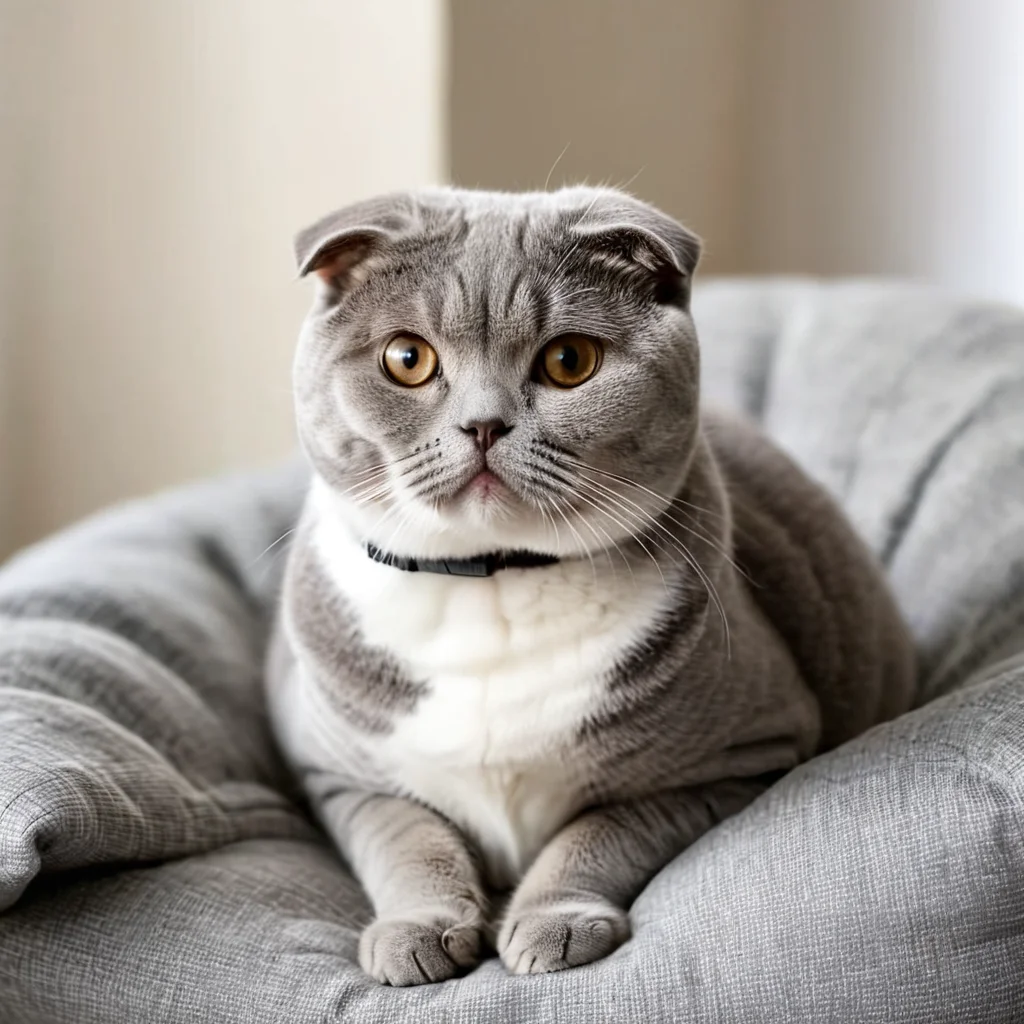

The Scottish Fold, with its folded ears + round face + big round eyes, is one of the most widely recognized cat breeds in the world. The breed started from a single cat in Scotland in 1961 and has become popular in recent years. However, the folded-ear trait is actually a genetic mutation: a cartilage disease called osteochondrodysplasia affects the entire breed. In this article we take a detailed look at the Scottish Fold's personality + care + the ethics debate + health problems.
1. Scottish Fold Personality
- Very gentle + affectionate: Gets along wonderfully with families + kids.
- Social: Good with other animals + people.
- Calm: Low energy.
- The "Buddha pose": Sitting upright on the hind legs is typical (actually for joint comfort).
- Meows little: Quiet.
- Attached to its owner: Follows you around.
2. Physical Traits
- Weight: Males 4-6 kg, females 3-5 kg.
- Coat: Short or long (Highland Fold).
- Folded ears: Straight at birth, they fold after 3-4 weeks.
- Color: Every color + pattern.
- Lifespan: 11-14 years.
3. Osteochondrodysplasia: An Important Ethical Issue
The gene that gives the Scottish Fold its folded ears affects all of its cartilage:
- Heterozygous (1 copy of the fold gene): moderately affected.
- Homozygous (2 copies of the fold gene): severe joint deformity, a painful life.
- Ethical breeder: pairs a fold with a straight-eared cat, producing only heterozygous kittens.
- Unethical: pairing two folds, producing homozygous kittens with poor quality of life.
- Scotland and some other countries do not recognize the breed (ethics debate).
4. Lifelong Joint Problems
Every Scottish Fold has some degree of joint involvement:
- Tail stiffness (test: is the tail flexible?).
- An odd leg stance.
- A reluctance to jump.
- Arthralgia + osteoarthritis increasing with age.
- A yearly joint assessment at the vet.
- Glucosamine + omega-3 support.
- Pain relief in severe cases.
5. Coat Care
- Short coat: brush once a week.
- Long coat (Highland Fold): 2-3 times a week.
- Baths rarely.
6. Ear Care (Important)
Folded ears get less airflow inside, which raises the risk of wax + bacteria buildup:
- Clean the ears once a week with a gentle vet ear solution.
- Bad smell, discharge, scratching = infection; see the vet.
- Head shaking more often than in straight-eared cats.
7. Breed-Specific Health
- Osteochondrodysplasia: See above.
- HCM (Hypertrophic Cardiomyopathy): Echo screening from age 2-3.
- Polycystic Kidney Disease (PKD): Genetic test.
- Ear inflammation: Common.
- Dental tartar.
8. Nutrition + Exercise
- Kitten: kitten food, 4-6 months.
- Adult: 50-80 g/day of dry + wet food.
- Joint-support food (glucosamine + omega-3).
- Exercise: light activity, NO excessive jumping.
- Scratching post: an extra horizontal type that is easy on the joints is recommended.
9. Think Before Adopting (An Ethical Issue)
- Ethical awareness: The Scottish Fold is a genetically painful breed; joint problems are unavoidable.
- An ethical breeder is a must: Heterozygous kittens with a straight-eared parent.
- DO NOT get a kitten from homozygous parents: Serious lifelong problems.
- Monthly costs: 1,500-2,500 Turkish lira + 2,000-5,000 Turkish lira/year for joint health in later years.
- Insurance is recommended.
- Consider an alternative: The British Shorthair (a similar look, with a health advantage).
10. Lifespan and Costs
- Lifespan: 11-14 years.
- Total lifetime cost: 250,000-450,000 Turkish lira.
The Scottish Fold is a sweet + gentle family cat, but its ethical + health issues are serious. An ethical breeder + a heterozygous kitten + yearly joint assessments + glucosamine support all call for responsible ownership. In the DoldurKabı app you can find Scottish Fold adoption listings + vet clinics on a map.









