


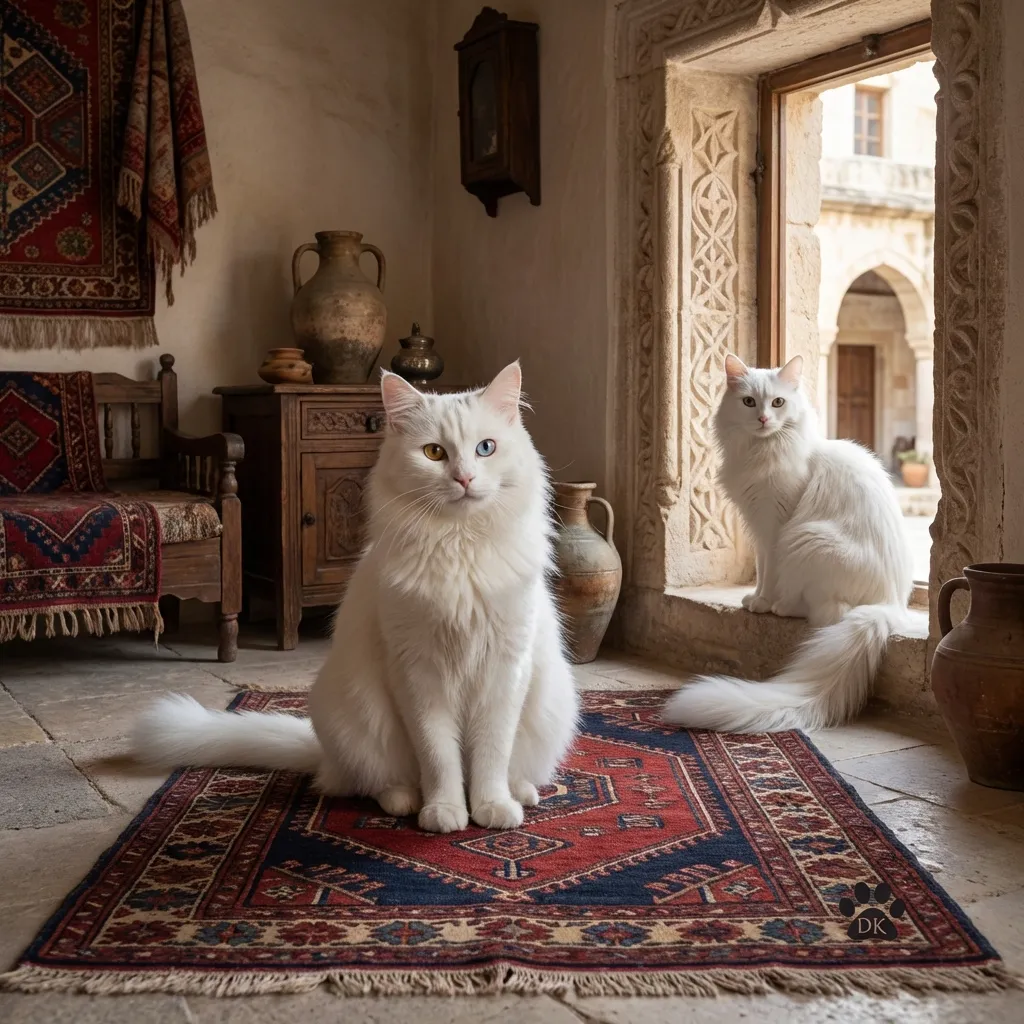

Anatolia's One-of-a-Kind Cat Heritage
Türkiye is one of the places in the world where house cat culture runs deepest. Over thousands of years, Anatolia has been a cradle where distinctive cat breeds evolved and were preserved. The Van cat, the Turkish Angora (Ankara kedisi) and the tabby are among the most recognized cats Türkiye has given the world. In this guide, we take a detailed look at the country's native cat breeds: their history, physical traits, personalities and care needs.
The Van Cat: The Legend of the Swimming Cat
History and Origins
The Van cat takes its name from the area around Lake Van, the jewel of Eastern Anatolia. The breed's history goes back thousands of years; cat figures have even been found on ancient reliefs at Van Fortress. In 1955, British photographer Laura Lushington came across these cats during a visit to Van, brought them to England and introduced them to the Western world. Living for centuries in an isolated region helped the Van cat keep its genetic purity.
Physical Traits
The Van cat has unique features that make it easy to tell apart from other cats:
- Eye color: Its most striking feature is having two eyes of different colors (heterochromia). One eye may be blue and the other amber or green. That said, there are also Van cats with two eyes of the same color
- Coat: It has a semi-long, silky, cashmere-like coat. There is no undercoat, so the fur repels water and dries quickly
- Color pattern: The body is completely white, with colored patches (usually reddish orange) on the head and tail. This is called the "Van pattern," and it has become a cat color term recognized around the world
- Size: It is medium to large with a muscular build. Males can reach 5-8 kg and females 4-6 kg
Its Unique Relationship with Water
What makes the Van cat truly unique is that it loves water and can swim. While most cats avoid contact with water, the Van cat enjoys playing in shallow water, pawing at running water and even swimming. This trait is thought to have developed as cats living on the shores of Lake Van survived for centuries by catching fish. Its water-resistant coat makes this behavior easier.
Personality
The Van cat is smart, energetic and independent. It loves to play and enjoys climbing to high places. It bonds strongly with its owners but doesn't really like being picked up; it prefers to come to you on its own terms. It usually gets along well with other cats but can show a dominant streak. It has a strong voice and lets you know out loud what it needs.
Conservation Work
The Van Cat Research Center at Yüzüncü Yıl University has worked since 1992 to protect this unique breed and maintain its purebred lines. The center runs regular breeding and offers controlled adoption to cat lovers. The Van cat is regarded as part of Türkiye's natural heritage, and its export is restricted by law.
The Turkish Angora (Ankara Kedisi): A Symbol of Elegance
History and Origins
The Ankara cat, or Turkish Angora, takes its name from the capital city of Ankara (formerly known as Angora). It is one of the oldest known long-haired cat breeds in the world. These were the first long-haired cats brought to Europe in the 16th century, and they drew great interest among the European aristocracy. King Louis XVI of France and Queen Marie Antoinette are said to have owned Angora cats. The breed was used as an ancestor in developing the Persian cat.
Physical Traits
- Coat: It has a long, silky, flowing coat. There is little or no undercoat, so the fur doesn't mat and is easy to care for. The coat falls naturally along the body
- Color: Although it is traditionally known as all white, it actually comes in many colors, including black, blue, red, cream and tabby. White is the most classic and most familiar variety
- Eye color: Eyes can be blue, amber, green or heterochromatic (two different colors). In white Angoras, a risk of deafness can be carried genetically along with blue eyes
- Build: It is slender, graceful and athletic. With its long legs and fine bones, it is the picture of elegance. Males weigh 3.5-5 kg and females 2.5-4 kg
Personality
The Turkish Angora is extremely smart, curious and social. It forms a strong emotional bond with its owners and is often known as a "one-person cat," attaching itself especially to one person in the family. It loves to play, climb to high places and explore. It can get along well with other cats and dogs. It is a chatty cat that keeps up a constant conversation with purrs and meows.
Care Needs
Even though it has long hair, it is surprisingly easy to care for. Because it has little or no undercoat, its fur doesn't mat easily. Brushing 2-3 times a week is enough. Shedding picks up seasonally, so it needs more frequent brushing in spring and fall.
Conservation Work
Ankara University and the Atatürk Forest Farm (Atatürk Orman Çiftliği) have worked for many years to protect the Turkish Angora and keep its purebred lines going. Atatürk's love of Angora cats is well known, and the cat sculptures at Anıtkabir reflect that affection. White Angoras are regarded as a national treasure of Türkiye and are protected through controlled breeding programs.
The Tabby: Anatolia's Street Star
Tabby Is a Pattern, Not a Breed
Tabby is actually a coat pattern, not a breed. Still, when people in Türkiye say "tekir," they usually mean Anatolia's street cats. Turkish tabbies are hardy, smart animals shaped by natural selection over centuries. Most street cats in Türkiye have a tabby pattern, and this pattern is inherited from the African wildcat, the common ancestor of all house cats.
Tabby Patterns
Four basic tabby patterns can be seen in Türkiye:
- Mackerel (Striped) Tabby: The most common pattern. Thin vertical stripes running along the spine look like a fish skeleton. It is the tabby pattern you see most often on the streets of Türkiye
- Classic (Marbled) Tabby: Wide, swirling patterns. A round motif known as a "bull's-eye" appears on the sides. It is less common than the mackerel tabby
- Spotted Tabby: Instead of stripes, it has round or oval spots and patches. This pattern also appears in breeds like the Ocicat and Bengal
- Ticked (Abyssinian) Tabby: There are no distinct stripes or spots. Each hair has bands of different colors, which gives an overall unspotted look
Physical Traits
Turkish tabbies are very rich in genetic diversity. They are medium-sized, muscular and athletic. They usually weigh between 3-6 kg. The characteristic "M" marking on the face is shared by all tabby cats. They come in many color combinations, in shades of gray, brown, orange, cream and black.
Personality
Turkish tabbies are known for being smart, independent and adaptable. The hardships of street life have made these cats extremely tough and resourceful. Once they move indoors, they bond strongly with their owners and make wonderful companions. Their hunting instinct is strong, so you won't have mouse or bug problems at home. They are usually social and get along well with other cats.
The Health Advantage of Tabby Cats
Genetic diversity is the biggest health advantage tabby cats have. Hereditary diseases seen in purebred cats are much rarer in tabbies. Thanks to hybrid vigor (heterosis), their immune systems are strong, and on average they live longer than purebred cats. With regular vet care, they can live 15-20 years.
Street Cats: An Inseparable Part of Turkish Culture
Historical and Cultural Importance
Cats have held a special place in Turkish culture for centuries. In the Ottoman era, cats were carefully looked after and respected in mosque courtyards and neighborhoods. Charitable foundations set aside special funds to feed and care for cats. This tradition continues today: Istanbul's neighborhoods are famous for their cats, and a 2016 documentary on the city's cats introduced Istanbul's street cats to the world.
Istanbul: The World's Cat Capital
Istanbul is known around the world as "the city of cats". An estimated 125,000 or more street cats live in the city. In neighborhoods like Cihangir, Kadıköy, Karaköy and Sultanahmet, cats are an inseparable part of street culture and tourism. Many restaurants and cafés keep their doors open to street cats. It is a common tradition for neighbors to feed the cats, leave out water and build shelters for them in winter.
The Role of Local Governments
In Türkiye, municipalities have legal duties to spay/neuter, vaccinate and treat street cats. Many municipalities try to improve living conditions for street cats by setting up feeding stations, water bowls and cat houses. The DoldurKabı app also serves as a bridge between residents and municipalities in this process.
Care Tips for Native Cat Breeds
General Health
For all of Türkiye's native cat breeds, regular vet checkups, up-to-date vaccinations and parasite protection are essential. White cats (Van cats and Angoras) should avoid long exposure to direct sunlight because of the risk of sunburn. A deafness screening is recommended for blue-eyed white cats.
Nutrition
High-protein, quality cat food is recommended for all breeds. Van cats may need a bit more calories because they are so active. With Angoras, watch out for obesity given their slender build. Clean water should always be available for every cat.
Coat Care
As long-haired breeds, the Van cat and the Turkish Angora need regular brushing. Since both have minimal undercoat, they are much easier to groom than other long-haired breeds (such as the Persian). For tabbies, brushing once a week is usually enough.
Conclusion: Protecting Anatolia's Wealth of Cats
Türkiye's native cat breeds are an important part of the country's natural and cultural heritage. The unique beauty of the Van cat, the graceful bearing of the Turkish Angora and the hardiness of the tabby are living witnesses to Anatolia's thousands of years of cat culture. Protecting this heritage and passing it on to future generations is a responsibility we all share. Through adoption, spaying/neutering and thoughtful care, we can help secure the future of these remarkable cats.






