
You are sharing a cozy moment with your cat on the couch, and suddenly they sink their teeth into your hand. For most owners, that is confusing. "They were just purring, what changed?" you wonder. But for cats, biting does not have just one meaning; sometimes it is a sign of affection, sometimes an invitation to play, and sometimes a message that says "that's enough now."
Reading the reason behind the bite correctly protects both you and your relationship with your cat. That's because each type of bite calls for a different response: getting angry at a love bite confuses your cat, while ignoring a fear bite makes the problem bigger. The wrong response can turn an innocent habit into a real behavior problem.
In this post, we go step by step through the five main types of biting, the body language signals your cat gives before each one, and practical ways to reduce biting.
Love Bites: Gentle and Controlled
One way cats build social bonds with each other is by gently nibbling one another while grooming. If your cat bites lightly without hurting your skin while you pet them or when they snuggle up to you, it's usually a love bite. It is brief, the jaw pressure is low, and it often comes with licking. Your cat is "grooming" you as if you were part of their family.
The right response is to stay calm. Yelling or pulling your hand away fast startles your cat and turns a sweet moment into a bad experience. If you don't like this kind of contact, slowly move your hand away and redirect their attention to a toy. Over time, your cat learns that this behavior gets no response from you.
Play Biting: This Is How Kittens Learn Limits
Kittens learn how hard to bite by wrestling with their littermates. When one kitten bites too hard, the other squeals and stops playing, which teaches the lesson "that's too rough." Cats separated early from their mother and littermates never fully learn this lesson, so they may develop rougher play bites toward human hands.
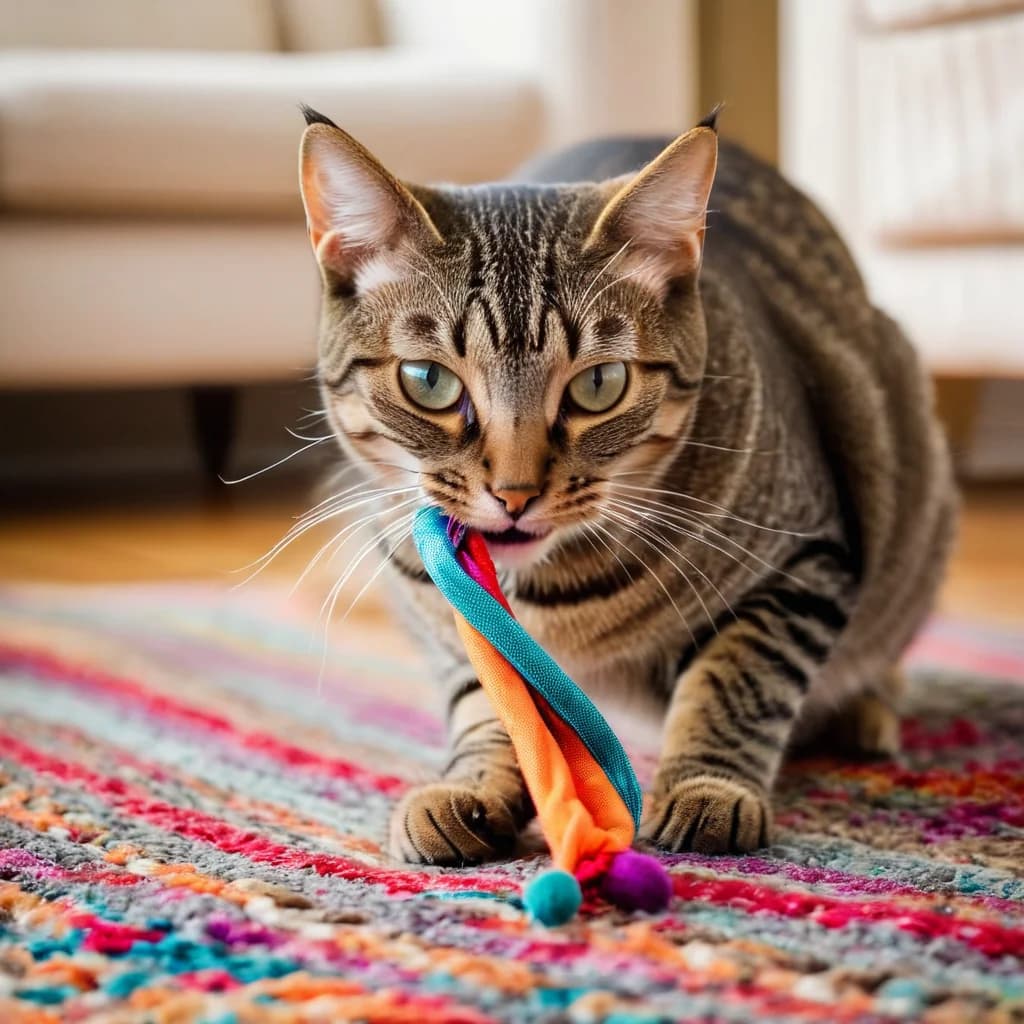
Play biting usually comes with hunting behaviors like stalking, wiggling the hips and pouncing suddenly. Your cat does not mean any harm; your hand or ankle is simply playing the role of prey at that moment.
The Golden Rule: Your Hand Is Never a Toy
One common source of biting problems is cats that were played with by hand as kittens. An owner who wiggles their fingers in front of a kitten and lets them catch them is unknowingly teaching the lesson "human hands are prey." This game looks cute with a kitten, but with an adult cat's jaws, it turns into a serious problem.
- Always use a wand toy, a ball or a plush mouse when you play, and always keep some distance between your hand and your cat.
- If your cat goes for your hand during play, stop moving completely and pause the game for a few minutes. Let them learn from experience that biting ends the game.
- At least two active play sessions of 10-15 minutes a day release pent-up hunting energy toward the right target.
Overstimulation: The Sudden Bite While You Pet
Here is something owners often complain about: your cat is purring in your lap, you are petting them, and then all at once they sink their teeth into your hand. This is called petting-induced aggression (petting aggression). Repeated touch builds up in a cat's nervous system; once a certain threshold is crossed, pleasure turns into discomfort, and your cat lets you know the only clear way they know, by biting.
Signals That Come Before the Bite
The good news: cats almost never bite truly "out of nowhere." These signs usually appear before a bite:
- The tail swishing side to side faster and faster, or the tip twitching
- The ears turning sideways or flattening back
- The skin on the back twitching in a rippling motion
- The pupils suddenly dilating
- The purring stopping, the body tensing, and the head turning toward your hand
When you see one of these signals, stop petting right away; if your cat is in your lap, let them get up. If a bite does come, holding your hand still is safer than pulling it away fast, because sudden movement triggers the hunting reflex and makes the bite harder. Keeping sessions short, focusing on areas most cats like such as the head and under the chin, and staying away from the belly and the base of the tail will also keep you far from that threshold.
Fear and Defensive Biting
A cat that is cornered, has its escape route blocked or is being held in a way it doesn't want will bite as a last resort. Before that, you usually see hissing, flattened ears, crouching and shrinking down, and a puffed-up coat. These bites are harder than the others, because your cat feels truly threatened.
The right response is not punishment but leaving an escape route. When there are lots of guests, when your cat is around kids or when the carrier comes out, don't force your cat into your arms; offer a safe corner where they can hide and wait for them to come to you on their own. Trust is built when contact is in your cat's control. Temperament also varies from breed to breed; in our cat breed encyclopedia you can see which breeds tend to be shyer and which are more social.
Pain-Related Biting: The Body Is Saying "Don't Touch"
If a cat that used to enjoy being touched starts biting when you touch a certain spot, take it seriously. Joint pain, tooth and gum problems, an ear infection or tummy sensitivity lower a cat's tolerance for touch. Cats are experts at hiding pain; sometimes biting is the only visible sign.
Especially in a senior cat, if new biting behavior comes with hiding, changes in appetite or restlessness, don't wait. A checkup with a vet near you will make it clear whether what you think is a behavior problem is actually a medical one.
Daily Strategies to Reduce Biting
- Channel their energy the right way: Regular play sessions, a scratching post, tunnels and puzzle toys give the hunting drive a healthy outlet.
- Respect the signals: Watch the language of the tail, ears and skin; end contact before you reach the threshold.
- Be consistent at home: Everyone should follow the same rule. If one person keeps playing by hand, the training resets every time.
- Don't use physical punishment: Hitting or spraying water increases fear, makes biting harder and destroys your cat's trust in you.
- Enrich the environment: A perch by the window, high places to climb and hiding spots reduce biting that comes from boredom.
Getting to know your cat's personality and energy level also makes your job easier; in the cat encyclopedia you can find detailed information on each breed's play needs and temperament.
Frequently Asked Questions
My cat licks me after biting. What does that mean?
If biting and licking come together, it is most likely social grooming behavior; it means your cat sees you as part of their group. If the bite is gentle, there's nothing to worry about. If it gets harder, check for overstimulation signals and shorten the session.
Does biting decrease with age?
In most cats, play biting softens around 1-2 years of age as their energy levels even out. But if the habit of playing by hand continues, the behavior becomes permanent. New biting in an adult cat, on the other hand, is not something you should expect to pass with age; it is a sign that should be checked for pain or stress.
Should I punish my cat when they bite me?
No. Cats don't connect punishment with the behavior; they only learn to be afraid of you, and that fear can increase biting rather than reduce it. The effective approach is to stop play and attention right after the bite, and once they calm down, offer the right target with a toy.
What should I do if the bite is deep and bleeding?
Wash the wound with plenty of soapy water and keep it clean. Cat bites are narrow but deep, so they carry a risk of infection; if you notice swelling, redness or increasing pain, go to a health care provider. If your cat has become unusually aggressive, don't skip a vet checkup either, in case there is an underlying condition.