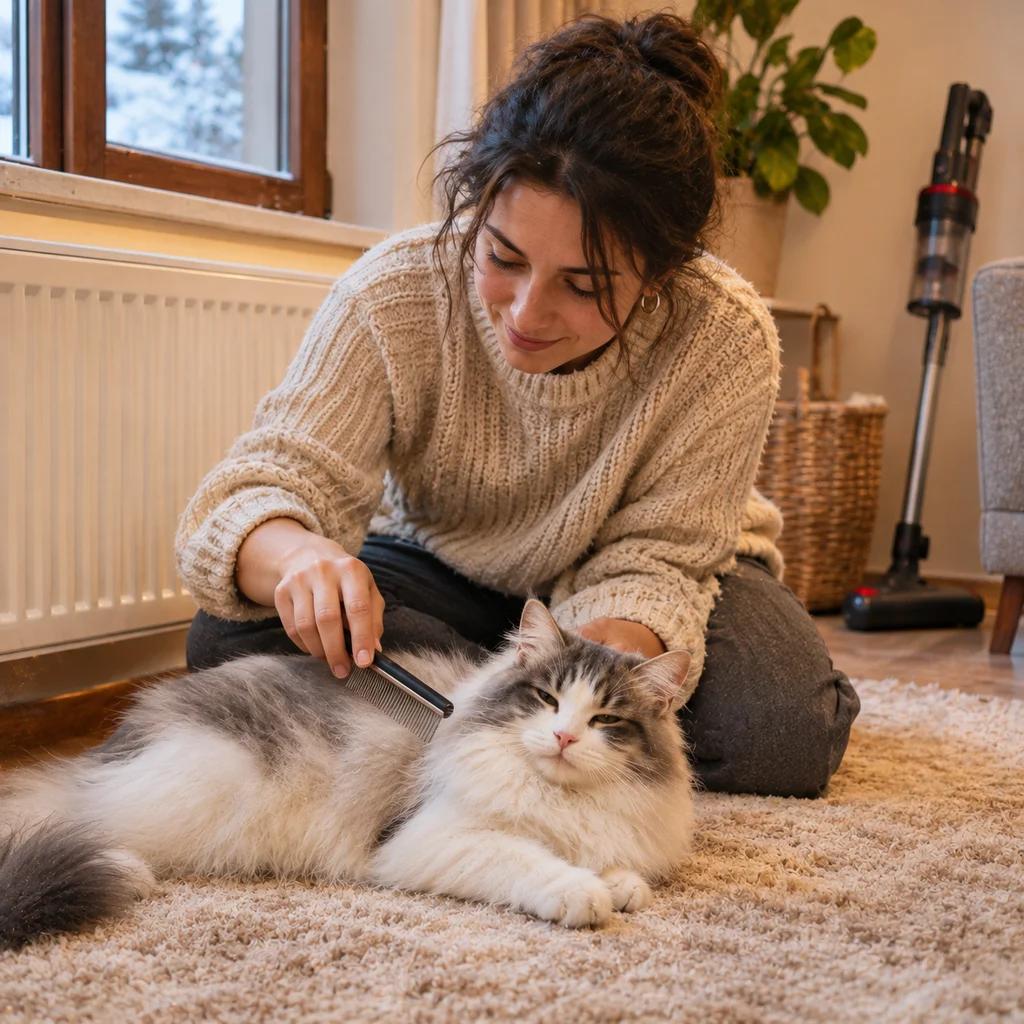

When we think of fleas and ticks, summer usually comes to mind. Lawns, wooded trails, vacation. Once the cold sets in, many people pause parasite treatments. The idea that "there are no fleas in winter" is common, but given indoor conditions, it is not always true.
In this post, we explain how parasites behave in winter, why your home can become a place for them to live and how you can plan a protection schedule. The decision about which product to use and how often belongs to the veterinarian who knows your pet.
Where do fleas go in winter?
Most of a flea's life is spent not on the animal but in its surroundings. Adult fleas on the animal lay eggs, and those eggs fall onto rugs, sofas, beds and the gaps in flooring. From there they move on to the larva stage and then the cocoon stage. Fleas in the cocoon stage can wait a long time and hatch when conditions are right.
Warmth and vibration are at the top of those conditions. A home with the heat on, thick rugs and a pet walking around is a very comfortable environment for fleas. That is why in some homes a flea problem suddenly starts in the middle of winter: cocoons that went unnoticed in the fall hatch as the home warms up.
Ticks do not disappear completely in winter either
Ticks are less active in the cold, but they do not vanish entirely over the winter. In regions with mild winters and on sunny, mild days, they can become active again. If you spend time with your dog in wooded areas, brushy places or the countryside, checking for ticks after walks is a good habit in the winter months too.
When checking for ticks, look inside and behind your dog's ears, at the neck, the armpits, between the toes and at the base of the tail. If you find a tick, do not try to pull it off by squeezing it with bare hands; ask your veterinarian how to remove it properly.
Internal parasites do not follow the seasons
For intestinal parasites, the animal's lifestyle matters more than the season. Cats and dogs that go outside, sniff things on the street, hunt, eat raw food or have contact with other animals stay at risk all winter. Fleas themselves can also carry some intestinal parasites. That is why the deworming schedule should not be put on hold automatically in winter either.
How can you tell if there are fleas?
Fleas are small and fast, and you cannot always see them. Watch for these signs:
- More scratching, especially around the base of the tail, the lower back and the neck.
- In cats, excessive licking and thinning fur in some areas.
- Tiny black specks at the base of the fur.
- Redness or scabbing on the skin.
- Small itchy bite marks on your own legs, especially around the ankles.
There is a simple way to tell whether the black specks are flea dirt: comb your pet with a fine-toothed comb over a light-colored towel and put the specks that fall onto a damp white paper. If they leave a reddish-brown stain, it may be flea dirt. If the itching is intense or there are sores on the skin, talk to your veterinarian.
How should you think about a winter protection schedule?
Whether or not to pause the protection schedule is a decision that depends on your pet's living conditions. Your veterinarian will suggest a plan based on the answers to these questions:
- Does your pet go outside, and if so, where does it spend time?
- Are there other animals at home, and do they have contact with the outdoors?
- Have you had a flea problem before?
- Is there a baby, an older person or someone with a weakened immune system at home?
- How mild are the winters where you live?
Once you have a plan, set a reminder so you do not miss treatment days. In the DoldurKabı app, you can add reminders for your pet's medications and log treatments in its health records. You can see how these records are kept on the health tracking page.
Do not mix up cat and dog products
Some parasite products made for dogs can be toxic to cats. If you have both a cat and a dog at home, store the products in separate places, and do not let the cat lick the dog after you apply a treatment. Talk to your veterinarian to choose a product suited to your pet's weight and species, and do not switch products based on the internet or someone's recommendation.
The street and shared building areas
In the winter months, street cats and dogs take shelter in building entrances, basements and boiler rooms. These warm spots can also be where fleas gather. When you pass through these areas with your own pet, do not linger, and give it a quick comb-through when you get home. Shoes and doormats are also one of the ways fleas get carried into the house.
Take your home into account too
If there is a flea problem, treating only the animal is not enough, because most fleas develop inside the home.
- Vacuum rugs, sofas, the edges of flooring and the places your pet sleeps regularly. Empty the vacuum bag or canister outside.
- Wash your pet's bed, blanket and the sofa covers you use at a high temperature.
- Do not forget the blankets you use in the car and the carrier.
- Treat all the cats and dogs in the home at the same time. Treating one and skipping the other keeps the problem going.
Fleas are not the only cause of itching
It is natural to look for fleas on any pet that is scratching in the winter months, but that is not the only explanation. The dry air in heated homes can dry out the skin and lead to flaking and itching. Food sensitivities, skin infections, other parasites such as mange mites and allergies can look similar. If the itching continues even though you cannot find fleas, or if there are sores, hair loss or a bad smell, the cause needs to be found through an exam.
In some animals with flea allergies, even a single flea bite can trigger itching that lasts for days. With these animals, not seeing fleas on them does not mean there is no problem. If there is a history like this, continuing protection through the winter months becomes even more important; talk this over with your veterinarian as well.
Take care with senior and sick animals
In senior, weak or chronically ill animals, a heavy flea problem can lead to more serious consequences such as anemia. Kittens and puppies are also vulnerable in this respect. Because both the choice of product and how often it is applied may be different for these animals, always leave the decision to your veterinarian.
If a new animal is coming home in winter
If you have taken in a cat or dog from the street in the cold or adopted a new pet, have it checked by a vet before introducing it to the other animals at home. Parasite status, vaccine schedule and an overall health assessment are done in the first days. You can find clinics near you in the vet directory.
Frequently Asked Questions
My cat never goes outside. Does it still need flea protection?
Indoor cats can come across fleas too; fleas can get into the home on clothes, shoes, other animals or through shared building areas. Even if the risk is lower, talk with your veterinarian about whether protection is needed.
What happens if I take a break in winter?
Some pets may have no problem, while in others, fleas that build up inside the home show up in the middle of winter. Making the decision with your veterinarian based on your pet's living conditions is easier than dealing with cleaning the whole house later.
Do flea powders or herbal collars work?
The effectiveness and safety of products vary a lot. Some herbal oils can also be risky, especially for cats. Choose which product to use after talking with your veterinarian.
We found fleas at home and treated our pet, but the fleas are still there. Why?
This happens very often, because the eggs, larvae and cocoons in the home keep developing without being affected by the treatment. As new fleas hatch from the cocoons, you see them on your pet again. That is why regular vacuuming, washing bedding and treating all the animals in the home together are needed. If the problem does not ease within a few weeks, talk to your veterinarian; you can review the treatment interval and home measures together.