


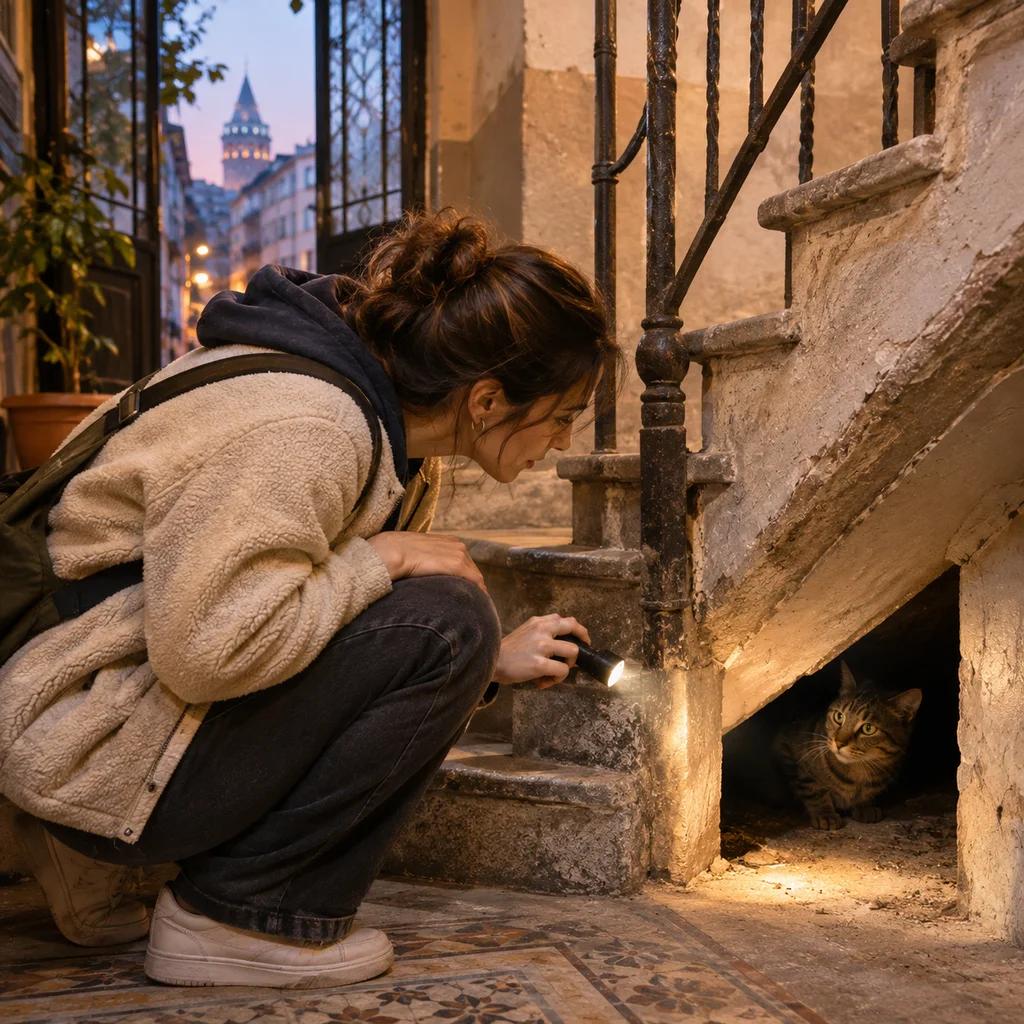

The moment you notice that a cat who has never been outside has slipped out the door, your first thought is to run around the streets. But an indoor cat usually does not go as far as you think. When it meets unfamiliar sounds, smells and open space, the first thing it does is crouch in the nearest hidden nook and go quiet. That is why, in the first 24 hours, patiently and quietly searching nearby works better than searching wide.
In this post we lay out, in order, what you can do from the first hour after the escape to the next day. You do not have to do everything at once; sticking to the order is enough.
Why doesn't an indoor cat go far, and why doesn't it come when called?
For a cat that does not know the outdoors, the world beyond the door is completely foreign. When frightened, cats tend to hide rather than run off and disappear. The underside of a car, the base of a bush, the edge of a basement window: that is enough for them. And in its hiding spot, it often does not make a single sound, because staying quiet means staying alive.
So the cat who comes running at home when it hears its name may not budge outside, even if it hears your voice. That does not mean it does not recognize you. Fear simply outweighs the urge to go toward a familiar voice. Accepting this as you plan your search protects you from the mistake of thinking "I called, it didn't come, so it must not be here."
The first hour: start inside the home and the building
Do not focus on the outdoors until you are sure it has escaped. Cats can get into surprising places at home too. Inside closets, behind the washing machine, under the couch, inside the bed base, the gaps behind kitchen cabinets and the boxes on the balcony are the first places to check. Grab a flashlight, get down low and wait a few seconds at each spot.
Then move on to the building's shared areas. If you live in an apartment, the cat often escapes not outside but into the stairwell. Check these spots one by one:
- The landings on the floors above and below, especially the top floor near the roof door
- Semi-enclosed areas such as the basement, coal room, storage room and shelter
- Next to the elevator shaft, the meter cabinets, the fire escape
- Shoe racks in front of neighbors' doors and behind doormats
Talk to the building attendant or manager right away. If the basement and storage doors are opened and closed during the day, your cat may have been shut in somewhere. Having those doors opened and listening quietly inside sometimes ends the whole search.
Have these with you when you go out to search
Having empty hands the moment you find your cat can lead to it getting away a second time. Pack a small bag and take it with you every time you go out:
- A strong flashlight and a spare charger for your phone
- A carrier with an easy-open door, or a large towel
- Some of the food or treats it is used to
- Your phone with its photo, to show to neighbors
Outside, close by: widen in rings
If it is not inside the building, go outside, but do not go far right away. Start from the point where the door opens, circle the building, then move on to the neighboring buildings, then both ends of the street. Indoor cats usually turn up in places next to their own building, within a few houses.
The places you need to check are generally low and enclosed. Under parked cars, at the base of garden walls, in clumps of bushes and ivy, under balconies, in piles of construction materials, in ventilation gaps. When looking with a flashlight, move the beam slowly. In the dark, a cat's eyes reflect light, and that glow is often visible before the cat itself.
At every spot, stop talking and listen. A slight rustle, the crackle of leaves or a faint meow may be your only sign. If you want to call out, do not shout; say its name softly, in the tone you use at home.
Note down the places you have searched
Mark the streets you have checked on your phone's map or on a piece of paper. Under stress, it is very easy to check the same spot three times and never look at the next street. If several people are searching, split up the directions and collect all updates with one person.
Evening and night: the real search hours
During the day, with traffic, children's voices and crowds, a frightened cat will not come out. When things quiet down, that is, late in the evening and toward dawn, the chance that it will come out of hiding and look around goes up. At these hours, walk around alone or with at most one other person, with a flashlight, quietly.
Bring a sound it knows. Shaking its food container, rustling a treat bag or a call word you always use may help. Make the sound, then wait. Even if the cat decides to come, it will do so within a few minutes, and hesitantly.
Let the door and familiar scents help
Some cats find their own way back and return to the front door at night. To make the most of this chance, make the area in front of the door familiar to it. You can leave a blanket it has slept on, or a T-shirt you have worn, in front of the door. If possible, have someone stay home and check the door every now and then.
Leaving lots of food in front of the door, on the other hand, can attract other cats and animals. That can make it harder for your own cat to come close. A small amount of food with a familiar smell is enough.
Tell the neighbors, post the listing on day one
While the search goes on, let the people around you know. Ask neighbors door to door and ask them to check their balconies and storage spaces. Put up a note with a photo at the building entrance, the nearby corner store, the pharmacy and the vet clinic. People see what they are paying attention to; someone who knows your cat's color will notice a shadow they see under a car.
Do not leave the listing for the next day. Posting a lost pet listing on the first day is the fast way to add more eyes to the search. On DoldurKabı, an approved lost pet listing appears on the map, and the app prepares a search poster that is ready to share. Also take a look at lost cat listings in your area; sometimes someone has already seen your cat and posted it as "found."
When you find it: don't rush
Running toward your cat when you see it can send it off to its next hiding spot. Crouch down, look at it with half-closed eyes, talk softly and wait for it to come to you. When it comes close, wrap it in a towel, pick it up and put it straight into the carrier.
Once you are home, first give it water and food in a quiet room. If you notice a wound, limping, trouble breathing or not eating, take it to a veterinarian. A cat that was outside for only a short time deserves a checkup too. Then think about how the escape happened: a door left open, a window left ajar, or a moment during a package delivery. Closing that same gap prevents the next escape.
Frequently Asked Questions
If my cat doesn't come when I call, does that mean it isn't nearby?
No. Frightened indoor cats often do not leave their hiding spot even when they hear their owner's voice. Stopping the calling, listening quietly and returning to the same spots at different times works better.
Should I search during the day or at night?
Both are needed, but the quiet hours are more productive. During the day, go around the building, the shared areas and the neighbors; late in the evening and toward dawn, search the immediate area again with a flashlight and a soft voice.
Does putting the litter box in front of the door help?
Some cat owners try putting used litter in front of the door to guide the cat by scent. Alongside that, a blanket it has slept on and someone at home checking the door make a simpler start.
How long before I should give up hope?
Lost cats are sometimes found days or even weeks later. Keep your listing up to date, call the clinics and the shelter near you at regular intervals to ask, and replace worn posters. Even if the search slows down, it matters that the listing stays open.









