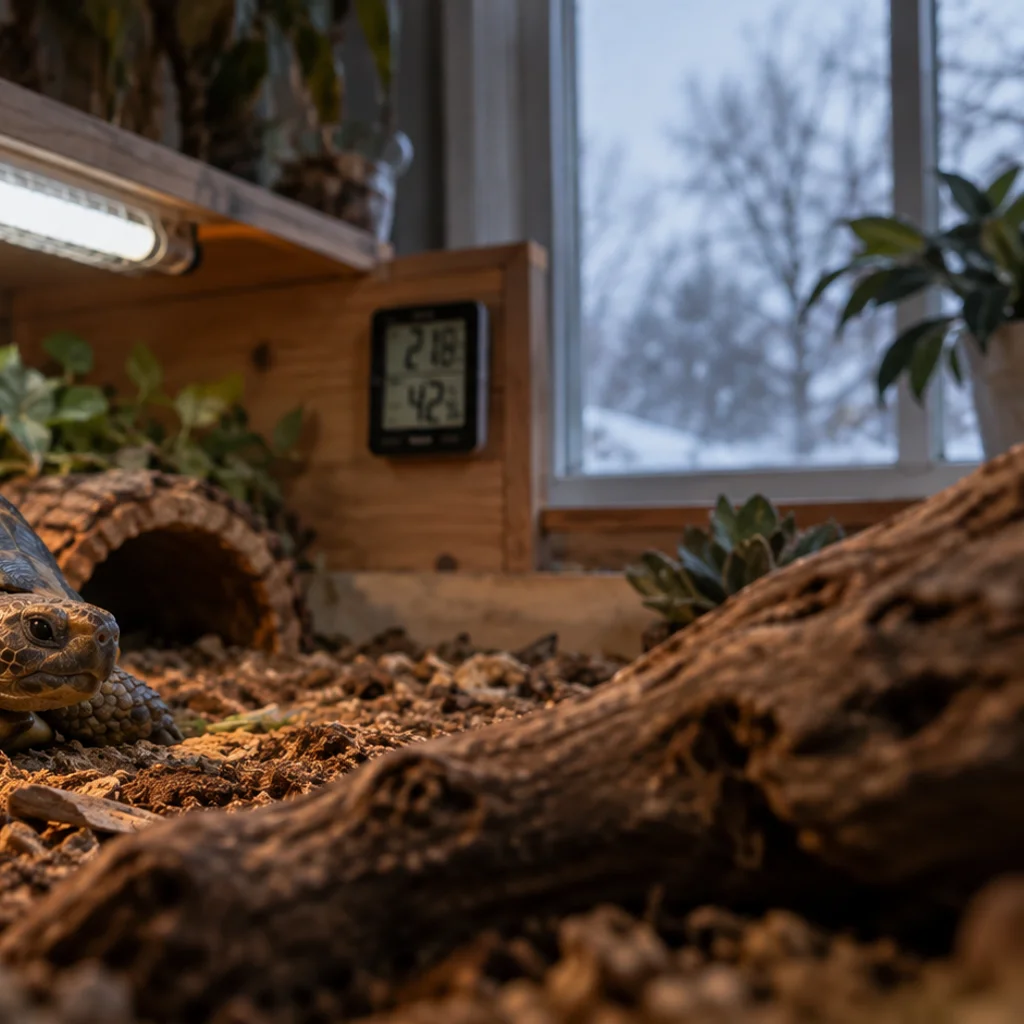

In reptile care, winter is the time of year when the most mistakes happen. The reason is simple: many things that fall into place on their own in summer quietly break down once the weather turns cold. The room temperature drops a few degrees, the days get shorter, the radiator dries out the air and the windowsill gets icy at night. The animal is in the same terrarium under the same lamp, but the environment it lives in is no longer the same.
Reptiles get their body heat from their surroundings. That's why, for them, temperature isn't a matter of comfort; it's a basic need that everything from digestion to immunity depends on. When the temperature drops, the animal slows down, stops eating and hides. Sometimes this is a normal seasonal change, and sometimes it's the first sign of a problem. Telling the two apart isn't something you can do by eye at home.
Below, we explain what to check as winter approaches, why the UVB and heat setup needs a fresh look, and what the decision about hibernation is based on. Let's start with the most important point: all of these decisions depend on species, age and health, and the final word belongs to a veterinarian who works with exotic animals.
Species first: not everyone spends winter the same way
Very different animals fall under the "reptile" heading, and their winter behavior differs just as much.
- Tortoises from temperate climates enter a period similar to hibernation in the wild. Whether to put them through this period at home is a separate decision.
- Species from tropical climates don't hibernate. For these animals, a drop in temperature isn't part of a cycle; it's a direct risk.
- For aquatic turtles, water temperature matters more than air temperature, and falling water temperatures in winter slow down digestion.
- Lizard and snake species also differ a lot in their temperature and humidity needs; what's normal for one species can be dangerous for another.
So a general statement like "reptiles sleep in winter" is of no use in practice. Knowing which species your animal belongs to and that species' natural living conditions is the foundation of a winter plan. For species-specific needs, see the turtle and tortoise species section or the Pet Encyclopedia in general; but do the real confirmation with the vet who sees your animal.
How do you notice a temperature drop at home?
The sneakiest problem in winter is the enclosure cooling down even though the heat source keeps working. The lamp is on and the basking spot is warm, but the cool side of the terrarium has dropped below what the species can tolerate.
That's why you need to update your measuring routine as winter approaches:
- Don't rely on a single thermometer. Measure the hot spot, the cool side and the nighttime reading separately.
- Place the thermometer at the height where the animal actually is; a reading on top of the glass doesn't show what's happening at floor level.
- Record the nighttime temperature for at least a few days in a row. A home can get much colder than you'd guess while everyone is asleep.
- Rethink where the terrarium sits: next to a window, against an outside wall and in front of a door are the riskiest spots in winter.
- Moving it next to a radiator or stove isn't the answer; that creates a risk of overheating and excessive dryness instead.
- Control heat sources with a suitable thermostat and fix the probe so the animal can't move it.
Humidity is another variable that changes in winter. Heated indoor air gets noticeably drier; in species with high humidity needs, this can set the stage for shedding problems and respiratory complaints. Add humidity readings to your winter checklist too.
UVB: why is it more critical in winter?
UVB isn't the same as visible light. A lamp may give off bright light while its UVB output has long since dropped. You can't tell this with the naked eye.
The issue matters even more in winter because the natural contribution disappears: the days get shorter, the sun's angle changes, and window glass blocks most UVB anyway. So the thought "it sits by the window, it gets sun" doesn't meet the UVB need.
- Keep a written record of when you replaced the lamp; the fact that it still gives light doesn't mean it's still effective.
- Check the distance between the lamp and the animal and whether anything is in between; glass and fine mesh can reduce UVB transmission.
- Set the lighting period according to the species' needs, and don't leave it on all day.
- Make sure there's always a shaded, covered area where the animal can retreat from the UVB zone; having a choice matters.
- Protect bulbs and cables from contact, water splashes and tipping over.
The hibernation decision: who makes it, and on what basis?
This is the question tortoise owners debate every fall: hibernate or not?
The most accurate answer here is that this decision shouldn't be made from general information read online, but together with a veterinarian who sees the animal. That's because the decision depends not only on species but on that animal's condition that year.
The points generally taken into account are:
- Health: For an animal that is sick, underweight or under treatment, this period carries added risk.
- Weight and overall condition: The vet assesses whether the animal has enough reserves to last through the period.
- Age: The approach may be different for very young animals.
- Digestion: The preparation time needed to empty the digestive system can't be overlooked.
- Control of the environment: In a home where the temperature can't be kept stable, it's hard to manage this period safely.
The real danger is leaving the decision up in the air. An animal kept in an environment with fluctuating temperatures, neither fully awake nor fully dormant, faces the riskiest situation: it doesn't eat because its metabolism slows, but it also burns through its reserves because it can't enter a full rest period. That's why, instead of staying undecided, you should talk to your vet and choose a clear path.
What should you monitor throughout winter?
A winter plan doesn't end with setting things up and forgetting about them. Things to watch throughout:
- Regular weight tracking; noticeable, rapid loss is an important warning sign.
- Changes in appetite and digestion.
- Noisy breathing, nasal discharge, foaming around the mouth.
- Swollen eyes, eyes staying closed, discharge.
- Stuck shed, leftover skin on the toes or tail tip.
- Unsteady movement, constantly lying on one side, unresponsiveness.
- Burn marks; these can appear in animals that come into direct contact with the heat source.
If you see any of these signs, don't lose time fiddling with the enclosure settings; go to a vet who works with exotic animals. You can find clinics in your area through our vet list and confirm before you go that the clinic sees reptile patients.
If you're thinking of bringing a reptile into your life, factor in the winter plan from the start; these animals need equipment, electricity and regular monitoring. When you look at adoption listings, one of the first questions to ask is whether you can meet that species' winter needs.
Frequently Asked Questions
My tortoise stopped eating. Is it going into hibernation right away?
Not necessarily. Loss of appetite can be the result of a temperature drop, but it can also be the first sign of a health problem. It isn't safe to tell the two apart by looking at behavior. Check the temperature and UVB readings, and if it continues, see your vet.
Should I leave the heat lamp on at night too?
That decision depends on the species. In many species, a slight drop in nighttime temperature is natural, but how much it can drop varies by species. If nighttime heating is needed, a heat source that doesn't give off light and a thermostat come into play; settle the choice with your vet.
When should I replace the UVB lamp?
A bulb that still gives light doesn't mean it's still producing UVB. Follow the usable life stated by the manufacturer and write down the replacement date somewhere. This item should be near the top of your checklist as winter approaches.
If there's no heating at home, how can I protect the terrarium?
Moving the terrarium away from outside walls and windows, insulating the back and side panels, putting insulation between it and the floor and partially covering the top reduce heat loss. Still, don't go by guesswork without measuring; record nighttime readings for a few days and see whether it's really enough.