
Dog barking is a natural way to communicate, but a dog barking nonstop in an apartment hallway at 11 p.m. wrecks both neighbor relations and peace at home. Instead of trying to "stop" barking, understanding the cause + teaching an alternative behavior is the only lasting solution. Shortcuts like anti-bark devices, electric collars or yelling to silence your dog make the problem deeper. In this post, we look at what triggers barking, 5 effective behavior techniques and when you need support from a veterinary behaviorist.
1. Why Dogs Bark: Find the Trigger
For effective intervention, you first need to answer the question what is my dog barking for. There are 6 main reasons:
- Alarm barking: The door, strangers, outside noises. Your dog is telling its pack "there's danger."
- Need barking: Hunger, needing to go potty, water, wanting to play.
- Boredom barking: Being left alone, a monotonous environment.
- Attention seeking: "Look at me," play, come here.
- Fear/defense: Feeling cornered, panicking.
- Excitement: A burst of joy when the owner comes home.
Keep a log for 2 weeks: the time of the barking, the situation, the trigger and how long it lasted. A pattern will emerge, and once the cause is clear, the intervention becomes clear too.
2. Technique 1: The Quiet Command ("Enough" / "Quiet")
Turn your dog going quiet into a command:
- Knock on the door to get your dog barking (this triggers the alarm).
- When your dog barks, say "enough" in a calm voice.
- When it stays quiet for a few seconds, give a treat + say "good dog".
- Trigger again, command again, reward again.
- In 7-14 days, your dog learns to stop barking when it hears "enough."
Important: yelling the command makes barking worse, because your dog thinks you're barking too. A calm voice + reward chain is what works.
3. Technique 2: Rewarding an Alternative Behavior
Instead of stopping the barking, teach a different behavior:
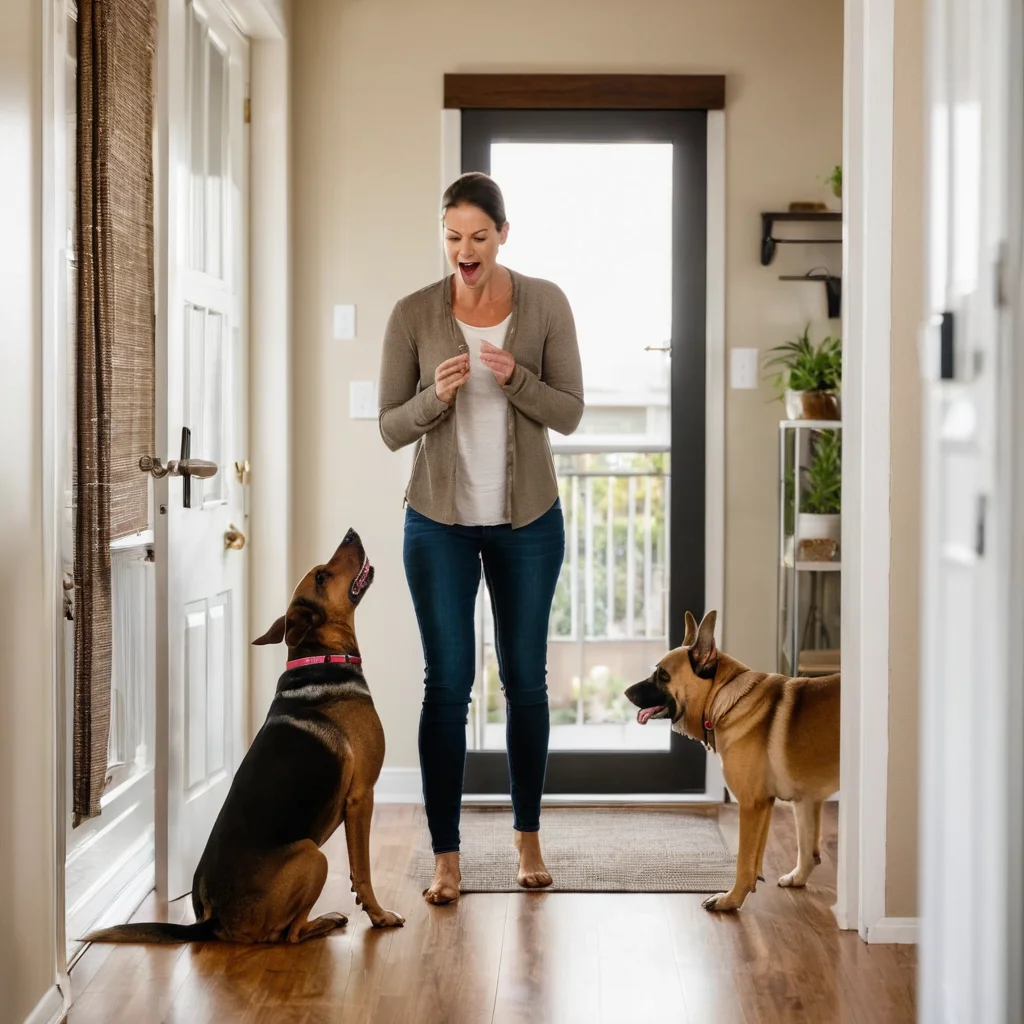
- The doorbell rings → your dog runs to its bed (a "place" command instead of barking).
- A stranger arrives → your dog sits and waits.
- In a moment of excitement → it runs and brings a toy.
This behavior can't be done at the same time as barking (if your dog goes to its bed for a treat, it stops barking). With 21 days of consistent rewards, it sticks.
4. Technique 3: Desensitizing the Trigger (Gradual Exposure)
Some triggers, especially the doorbell or the neighbor's noise, may be overloaded for your dog. Systematic desensitization:
- Start the trigger at very low intensity (play a doorbell sound on your phone, turned way down).
- If your dog doesn't react, reward.
- Slowly increase the intensity (turn the phone sound up a bit, then move to the real doorbell).
- Reward consistently for 2-3 days at each level.
- Within 4-6 weeks, the trigger becomes a "treat is coming" signal, and waiting replaces barking.
5. Technique 4: Redirecting Energy (Exercise + Mind)
An under-stimulated dog uses barking as entertainment. Add to the daily routine:
- Physical exercise: 2 × 30-45 minute walks + 15 minutes of play.
- Mental exercise: Sniffing games, a snuffle mat, a puzzle feeder, hide-and-seek games.
- Social interaction: Play with other dogs, training sessions.
"Tired dog = quiet dog." This simple rule solves the root of most barking cases. Mental tiredness is 2-3 times more effective than physical tiredness.
6. Technique 5: Managing the Environment
Reduce exposure to triggers:
- Window management: Put a white sheer curtain on windows facing the street + block the bottom half. Visual triggers drop.
- White noise: It masks street sounds. A TV, radio, fan or white noise app.
- Not being left alone: In a dog left alone for too long, separation anxiety makes barking explode. Options include a pet sitter, daycare or another pet for company.
- A dog bed away from the street: An inner corner of the home instead of the living room, so your dog isn't constantly sounding the alarm.
7. The Danger of Anti-Bark Devices
There are various "bark-stopping" devices on the market. In the long run, they are harmful:
- Electric collar (e-collar): It causes pain. It leads to a fear-aggression spiral, panic and escape behavior in dogs. It has been legal (it's debated in Türkiye), but behaviorists clearly oppose it.
- Ultrasonic bark stopper: A disturbing high-frequency sound. Stress + ear sensitivity in young dogs. There are studies showing it isn't effective in older dogs either.
- Citronella spray collar: It sprays your dog's nose. The effect is temporary; dogs get used to it.
- Shock collar: The most dangerous. Lasting trauma + loss of trust in the owner.
These devices don't answer the question "why is my dog barking"; they just scare the dog into silence. The root cause (loneliness, fear, boredom) doubles.
8. The Effect of Sex and Breed
Some breeds are genetically more "vocal":
- Frequent barkers: Beagle, Yorkshire Terrier, Chihuahua, Schnauzer, Cocker Spaniel, Pomeranian, Husky.
- Relatively quiet breeds: Basenji (doesn't bark, it howls), Greyhound, Bullmastiff, Newfoundland, Akbaş.
For vocal breeds, the goal isn't "zero barking" but "controlled barking"; you can teach them to start and stop on command.
9. Early Training in Puppies
During the socialization window of 4-12 weeks, you can shape barking behavior:
- Introduce your puppy to different sounds, places and people.
- Don't reward the first bark with attention; reward when it stays quiet.
- Introduce triggers like the doorbell and elevator sounds little by little.
- Establish basic commands like "down," "lie down" and "stay" by 4-6 months.
10. When Should You See a Veterinary Behaviorist?
Professional support is needed in these situations:
- No improvement despite 6 weeks of consistent behavior work.
- Barking that comes with aggression (trying to bite behind the door).
- Your dog barks nonstop for 4-8 hours when left alone (separation anxiety).
- Barking that starts suddenly without any change in the environment (a medical cause such as pain or cognitive decline).
- A sudden increase in vocalizing in a senior dog (CCS, canine dementia).
A combined approach of a veterinary behaviorist + a daily tracking program + sometimes temporary anti-anxiety medication brings improvement in 80% of cases within 8-12 weeks.
Barking isn't a problem; it's a signal. With the trio of understanding the cause + teaching an alternative behavior + managing the environment, you create peace for both your dog and your neighbors. Without turning to quick-fix devices, a consistent 6-8 week program solves most cases for good.