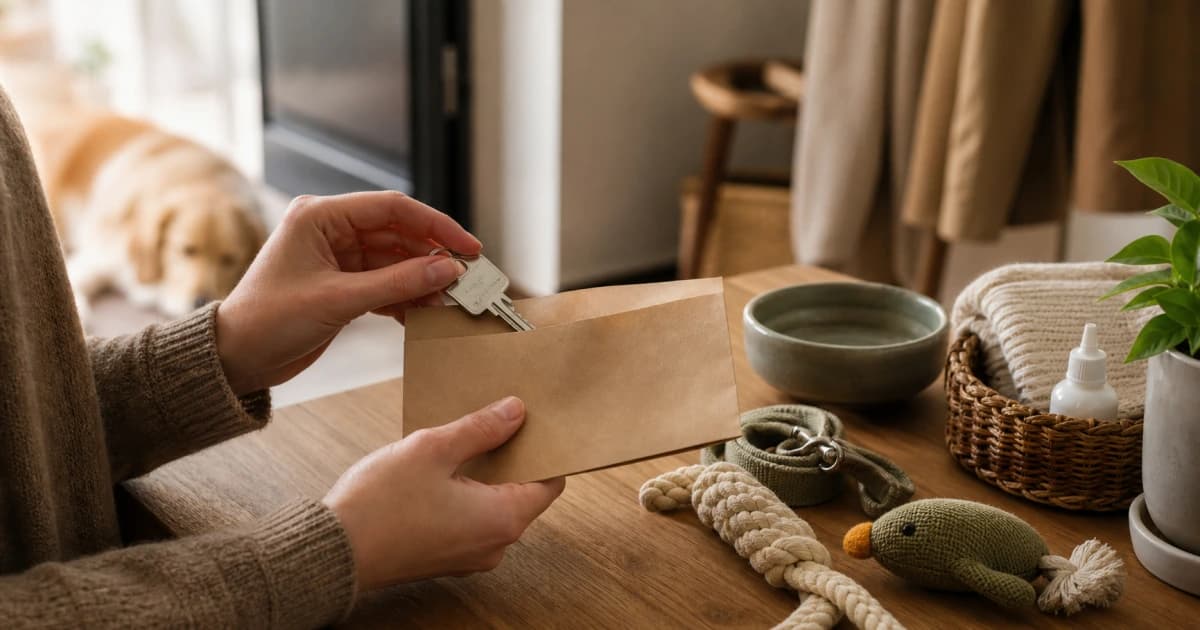

Taking a client's house key means you are responsible not only for a care task but also for access to a private space. Trust is not built with "don't worry." It is built with a simple process that can be tracked. Apply the same system with every client, from the moment you receive the key until you return it.
Instead of explaining how to get started in the profession from scratch, this post focuses only on one problem: "Key Handover and Home Entry in Pet Care: A Trust and Record System." To set up a workable system, you will first define the scope, then put the record-keeping and communication steps in place. Using the same order of checks with every client cuts down on improvised decisions that change from person to person.
Have both sides confirm the handover
Record the number of keys, the handover date and the person who handed them over in a message. If there is a spare key or a building access card, list each one separately. Testing the key while the client is with you lowers the risk of getting locked out on your first solo visit.
When you apply this step, base your decision on visible information, not assumptions. For "have both sides confirm the handover," record what was discussed in a dated note, confirm that the other person understood it, and do not keep going on an old agreement when conditions change. Clearing up a small uncertainty before the job starts is safer than making a rushed decision during care.
Store it without identifying details, but distinguishable
Do not write the address, the client's name or the pet's name on the key. Use a random code in your own record system and keep the code mapping in a separate place. Set aside a closed compartment where daily keys won't get mixed up with the other keys in your home.
When you apply this step, base your decision on visible information, not assumptions. For "store it without identifying details, but distinguishable," record what was discussed in a dated note, confirm that the other person understood it, and do not keep going on an old agreement when conditions change. Clearing up a small uncertainty before the job starts is safer than making a rushed decision during care.
Talk about the limits of home entry
Find out in advance which rooms you will be working in, which areas are off-limits, the alarm steps and any cameras in the home. If a family member, cleaner or another sitter will be in the home, avoid overlapping times. If you run into someone you don't know, call the owner before going in.
When you apply this step, base your decision on visible information, not assumptions. For "talk about the limits of home entry," record what was discussed in a dated note, confirm that the other person understood it, and do not keep going on an old agreement when conditions change. Clearing up a small uncertainty before the job starts is safer than making a rushed decision during care.
Create a visit log
Share a short report with your entry and exit times, the tasks completed and anything unusual. When taking photos, keep private papers, screens and family photos out of the frame. This record keeps the client informed and reduces disputes about missed visits.
When you apply this step, base your decision on visible information, not assumptions. For "create a visit log," record what was discussed in a dated note, confirm that the other person understood it, and do not keep going on an old agreement when conditions change. Clearing up a small uncertainty before the job starts is safer than making a rushed decision during care.
Don't hide a lost key or a broken lock
If the key is lost, tell the owner without delay; do not hide it and try to get a copy made. If the lock doesn't work, stop forcing it, wait in a safe place and get directions from the owner. If the animal has an urgent need, weigh alternative access and vet support together.
When you apply this step, base your decision on visible information, not assumptions. For "don't hide a lost key or a broken lock," record what was discussed in a dated note, confirm that the other person understood it, and do not keep going on an old agreement when conditions change. Clearing up a small uncertainty before the job starts is safer than making a rushed decision during care.
Make the return your closing step
Do not leave the key in a place that was not agreed on in advance, like under the doormat. Return it by hand, in a secure lockbox or by a method the client has clearly chosen, and get the handover confirmed in writing. For how to organize home visits, use our cat and dog sitting guides.
When you apply this step, base your decision on visible information, not assumptions. For "make the return your closing step," record what was discussed in a dated note, confirm that the other person understood it, and do not keep going on an old agreement when conditions change. Clearing up a small uncertainty before the job starts is safer than making a rushed decision during care.
How do you keep a record of your decisions?
Record not only the outcome of the decisions you make here but also the information behind them. The detail the client told you, your own observation, the method you agreed on and any later change should each be visible separately. Instead of scattering messages across different apps, use a single record thread for the service. That way, when the question "Did we talk about this?" comes up during care, you won't have to rely on memory.
The language of your records should be short, neutral and limited to what the job needs. Do not add personal comments, diagnoses, accusing language or unnecessary private information. For example, when a problem comes up, write only what was seen and when, who was called and what answer you got. If a photo is needed, take it without getting private areas of the home or personal documents in the frame. When the job is done, also review which information you will keep and for how long.
Do a small trial run before the first job
See whether the system on paper works in real life with a low-risk trial run. While the owner is with you, check that the key opens the door, that the contact numbers are up to date, where the needed equipment is and which channel you will report through. This trial run is not a sign of mistrust; it is a practical check that shows both sides understand the same process.
Do not cover up a gap you notice during the trial run with temporary fixes. If it can be fixed before the job starts, confirm the new arrangement in writing; if it can't be made safe, postpone or decline the service. Don't give in to pressure to hurry, especially if there is a health symptom, an escape risk or a problem accessing the home. A calm postponement is a more responsible decision than promising care under unclear conditions.
A short, practical checklist
- Confirm the scope and critical information in writing before you start.
- Postpone or decline anything that goes beyond safety or your skill limits.
- During care, record only observable information, with the date and time.
- When something changes, get the owner's approval; don't move forward on a verbal assumption.
- When the job is done, close out the handover, the report and any payment record in the same file.
This list alone does not solve every scenario; its purpose is to keep critical steps from being forgotten. Simplify it regularly to fit your own way of working, but try not to remove animal safety, clear communication and record-keeping.
Frequently Asked Questions
Should I take a photo of the key?
It can create unnecessary detail and a risk of copying. In most workflows, recording the number of keys and the handover in text is more measured. Double-check the answer against your own service terms and current information; settle any uncertainty in writing before the job starts.
What if the client asks me to keep the key?
Set the storage period, how they can ask for it back and the security arrangement in writing; do not agree to an open-ended, unclear arrangement. Double-check the answer against your own service terms and current information; settle any uncertainty in writing before the job starts.
What should I do if there are cameras in the home?
Talk about the cameras and the areas they cover before you start; if anything about privacy is unclear, do not take the job. Double-check the answer against your own service terms and current information; settle any uncertainty in writing before the job starts.