
For a pet grooming salon, a shop that looks good is not automatically the right location. Customers need to reach it comfortably with their pets and drop off quickly, the team needs to work safely, and the day's appointments need to run without delays. If you think about location and capacity planning separately, you can end up with a salon that carries high rent but can't be used efficiently.
The guide to opening a pet grooming salon covers the setup topics in general. In this post, we bring foot traffic, neighborhood demand, workstations, session length and no-show management together in one operations table. The goal is not to make a precise revenue forecast, but to build assumptions you can test before deciding on a shop.
Foot traffic is not always the right demand
Plenty of people may walk down a busy street, but they may not need regular grooming services for their pets. Heavy foot and car traffic can also make it harder to get in and out with an animal. Visibility matters, but don't decide based on crowds alone without measuring how your target customers can actually reach you.
Observe the candidate spot on different days and at different times. Take notes on people walking their pets, nearby housing density, public transit, the chance to stop briefly, and sidewalk and entrance conditions. This observation is not official demand data, but it helps you understand how the shop would be used day to day. If you already have customers, record which neighborhoods they come from and what matters to them about getting there.
Compare a neighborhood salon with a central location
A salon inside a neighborhood can offer closeness to regular customers and a calmer drop-off flow. A central location can offer visibility and access from a wider area, but it can bring pressure from rent, traffic and parking. Compare the two options not just on monthly rent, but on customer travel time, staff commutes and the risk of delays between appointments.
Put together a simple scorecard. Give separate scores for lease terms, visibility, access, quick drop-off, entrance safety, interior suitability, renovation needs, noise impact and the real customer base nearby. Add a weight to each criterion based on how much it matters to your business. This method tests an emotional attachment to a shop against operational criteria.
Walk the route from the door to the work area
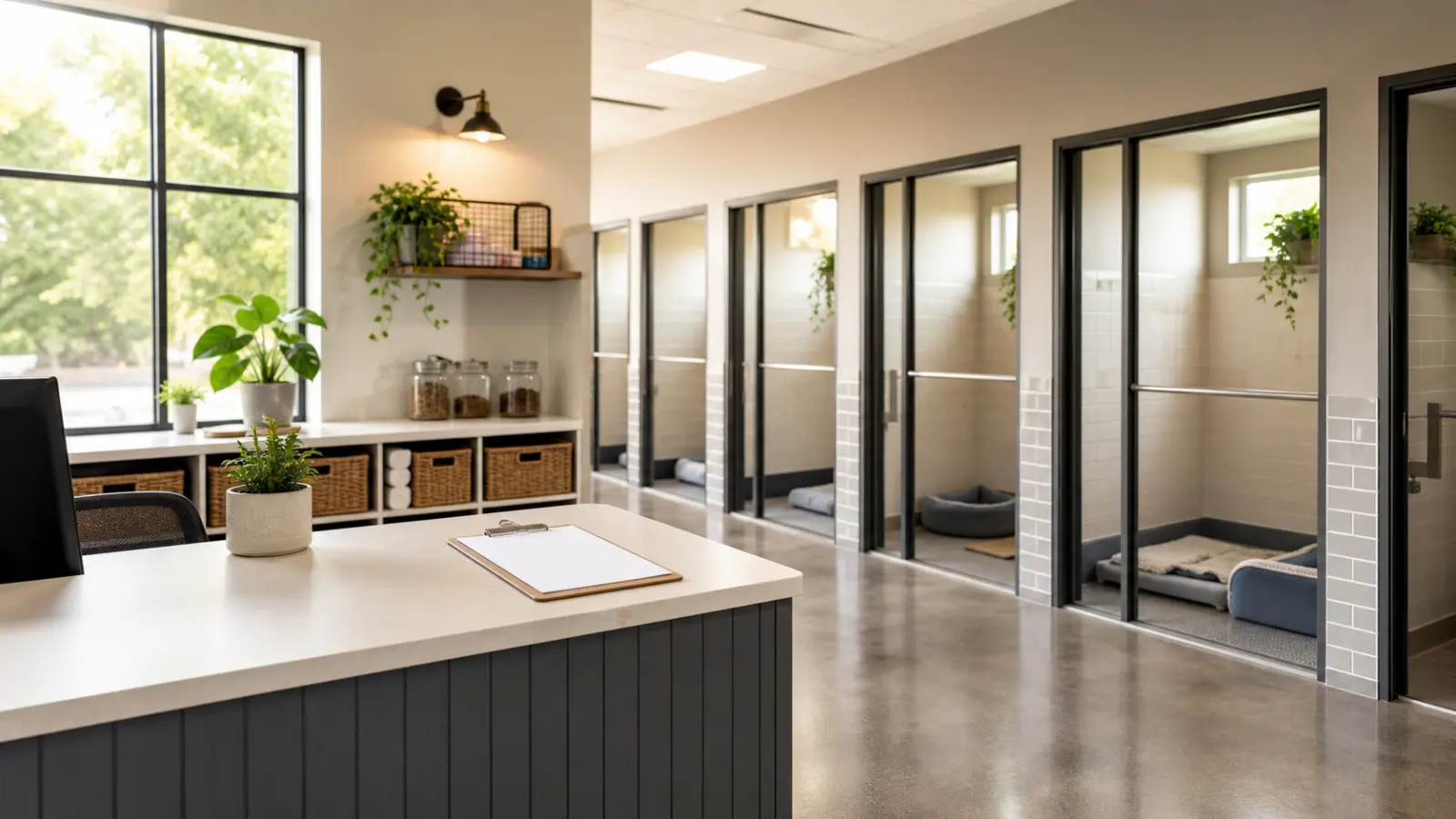
On the floor plan, trace the customer's path from the entrance to the reception point, the pet's path from the waiting area to the workstation, and the staff's path from the station to the washing and storage areas. Wet and dry areas that constantly cross each other can increase the cleaning load. Tight turns, slippery floors, steps or doors that collide make the daily flow harder. Before renovating, test these routes with the real dimensions of your equipment.
Set the number of workstations together with staffing
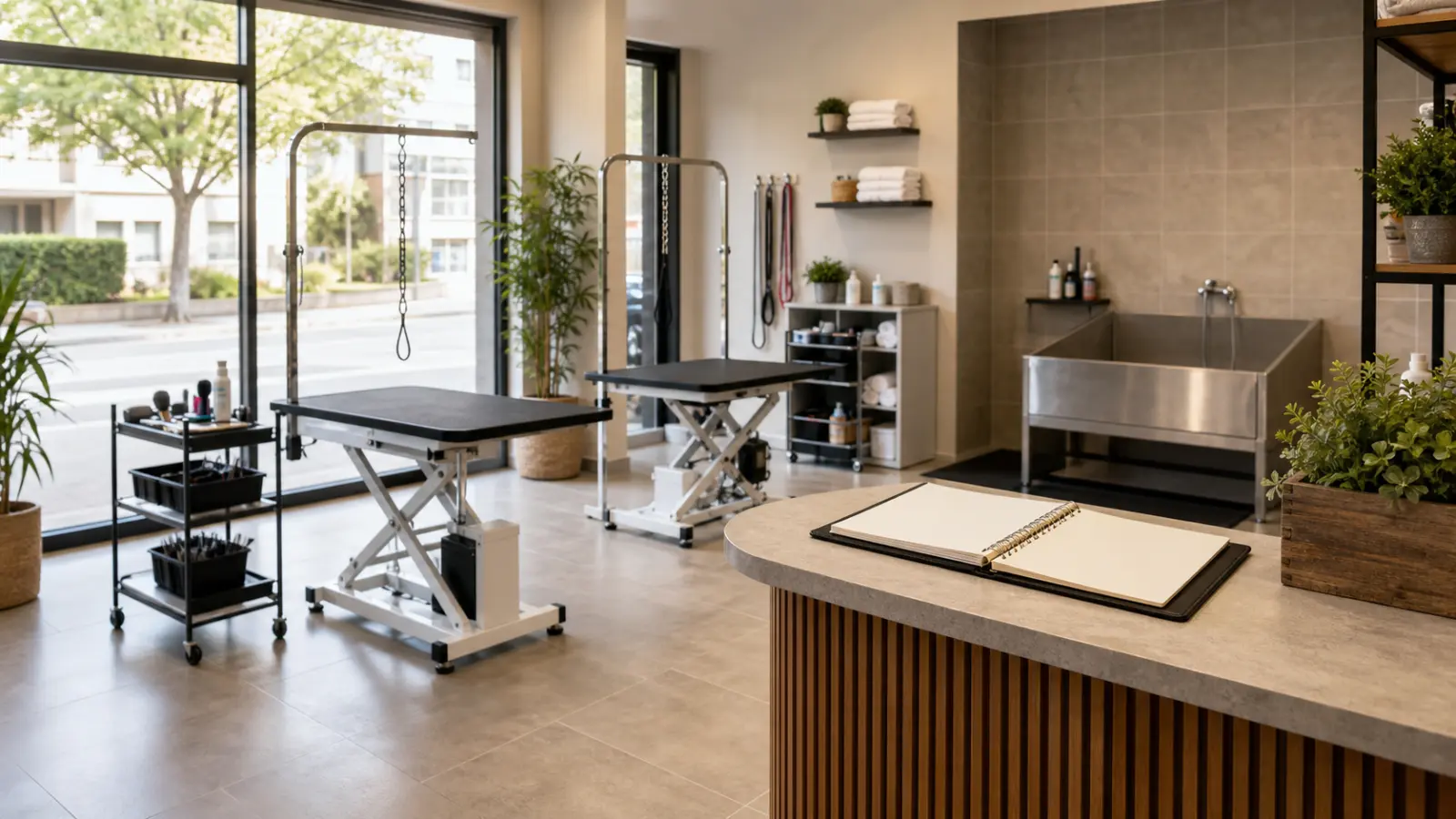
Being able to fit two tables in the salon doesn't mean you can run two full sessions at once. The washing area, drying equipment, a safe waiting spot and trained staff to do the work also limit simultaneous capacity. When one station blocks the path to another, or a line forms at shared equipment, total efficiency drops.
For each station, write down the space it needs, its electrical and water connections, equipment access and cleaning turnaround. Then determine how many people can actually work independently during a shift. Salon capacity should be planned according to whichever is lowest: the number of physical stations, usable shared equipment or staff. Make the prep and cleaning contribution of support staff visible task by task, too.
Don't squeeze session length into a single average
Service time varies with the pet's size, coat type, the chosen service, grooming history, how well the pet cooperates and the pick-up conversation. Giving every appointment the same amount of time creates gaps on some days and chain reaction delays on others. Sort your services into duration classes and record actual finish times regularly.
Appointment length includes not just the service itself, but also the greeting, notes on the pet's needs, prep, cleaning the area, payment and handover. If this transition time doesn't show up on the calendar, staff will greet the next customer with a station that isn't ready. When you measure, defining the start of a session as the moment the customer walks in, and the end as the moment the station is ready for use again, gives more realistic results.
Adjust buffer time by service
Instead of adding the same gap between every appointment at random, track which services cause time overruns. A first-time customer, grooming with an unclear scope, or a session that requires heavy equipment cleaning may need a wider buffer. A regular customer's well-defined service allows for more predictable planning. A buffer is not unsold lost time; it is part of your capacity that keeps a delay from spreading across the whole day.
Build daily appointment capacity with a formula
First, find the time each staff member can actually spend on services. Subtract breaks, opening and closing tasks, cleaning, supply prep, phone calls and handover conversations from the total shift time. Dividing the remaining time by the average total duration of your service classes gives you a theoretical number of appointments. Even if the result is a whole number, you still need to check the mix across the day.
For example, not every appointment will be a short service. How you place large time blocks and short services on the calendar affects the gaps. So instead of one daily number, prepare service mix scenarios. Using real records, keep updating which combination of appointments the team can finish on a quiet, normal and busy day without being overstretched.
Don't use the waiting area as sales capacity
Accepting more pets early may seem to ease the calendar, but a waiting area requires noise control, safety and staff supervision. Bunching drop-off times together more than necessary creates crowding at the entrance. Offering customers set drop-off windows and defining in advance what happens when someone arrives early creates a more controlled flow.
Set the number of waiting pets the salon can accept separately from active session capacity. This number depends on physical space, safe separation and how much supervision staff can provide. When the area is full, you may need to offer the customer a suitable time instead of accepting a new appointment early.
Make your no-show and late arrival policy clear
Missed appointments, last-minute cancellations and late arrivals directly affect the day's capacity. A very strict approach can strain customer relationships; having no rules at all leads to empty slots happening again and again. When booking, share in plain language the cancellation window, whether the service scope changes if someone is late, and what step you take when it keeps happening.
Reminder messages, location details and a short confirmation before the appointment can reduce forgetting. But filling every gap with overbooking is not the answer. If everyone shows up, you end up with a schedule the salon can't handle. Instead, keep a waiting list; when a suitable slot opens up, contact customers with flexible time windows in order.
Manage the calendar from one place
Appointments scattered across phone calls, social media messages and paper notes increase the risk of double booking. appointment management can help you keep service length, staff, stations and customer notes on a shared calendar. When choosing a system, consider needs such as mobile access, a change log, reminders and availability per staff member.
The calendar should show not only customer appointments, but also non-sales blocks such as equipment maintenance, cleaning, stock deliveries and staff meetings. Otherwise, a time slot that looks open may actually be unusable. At the end of each week, compare planned and actual times and update your capacity settings.
Collect pilot data before signing a lease
If you offer home or mobile services, your existing appointment records by area, day, service type, duration and cancellations are a strong starting point for choosing a location. If you don't have customer data yet, you can hold conversations in the candidate area, observe the surroundings and run a limited pre-demand test. These signals don't promise sales; they are only evidence that strengthens or weakens an assumption.
Before renting, confirm the license, permitted use, renovation permit, building conditions and local requirements with the relevant authorities. Renovating an unsuitable space can create costs that are hard to undo. Make your decision after both the demand scorecard and the technical suitability check are complete.
Frequently Asked Questions
Should a pet groomer be on a busy street or in a residential neighborhood?
There is no single right answer. A busy street can provide visibility; a neighborhood location can offer closeness to regular customers and a calmer drop-off. Compare rent, access, short-term stopping, target customer density and interior suitability on the same scorecard.
How many appointments can one staff member take per day?
It depends on the type of service, the pet's profile, shared equipment and prep time after each session. Subtract non-sales tasks from the shift, record real session times and set capacity based on your service mix.
How many workstations should a salon have?
The number of tables that fit in the space isn't the only measure. Staff, washing and drying capacity, safe passage and cleaning flow should be considered together. If a line forms at shared equipment, an extra table may not increase daily capacity.
Should you overbook to cover no-shows?
Taking so many bookings that you can't serve everyone if they all show up creates operational risk. A clear cancellation policy, reminders, confirmations and a waiting list of flexible customers are more controlled tools.