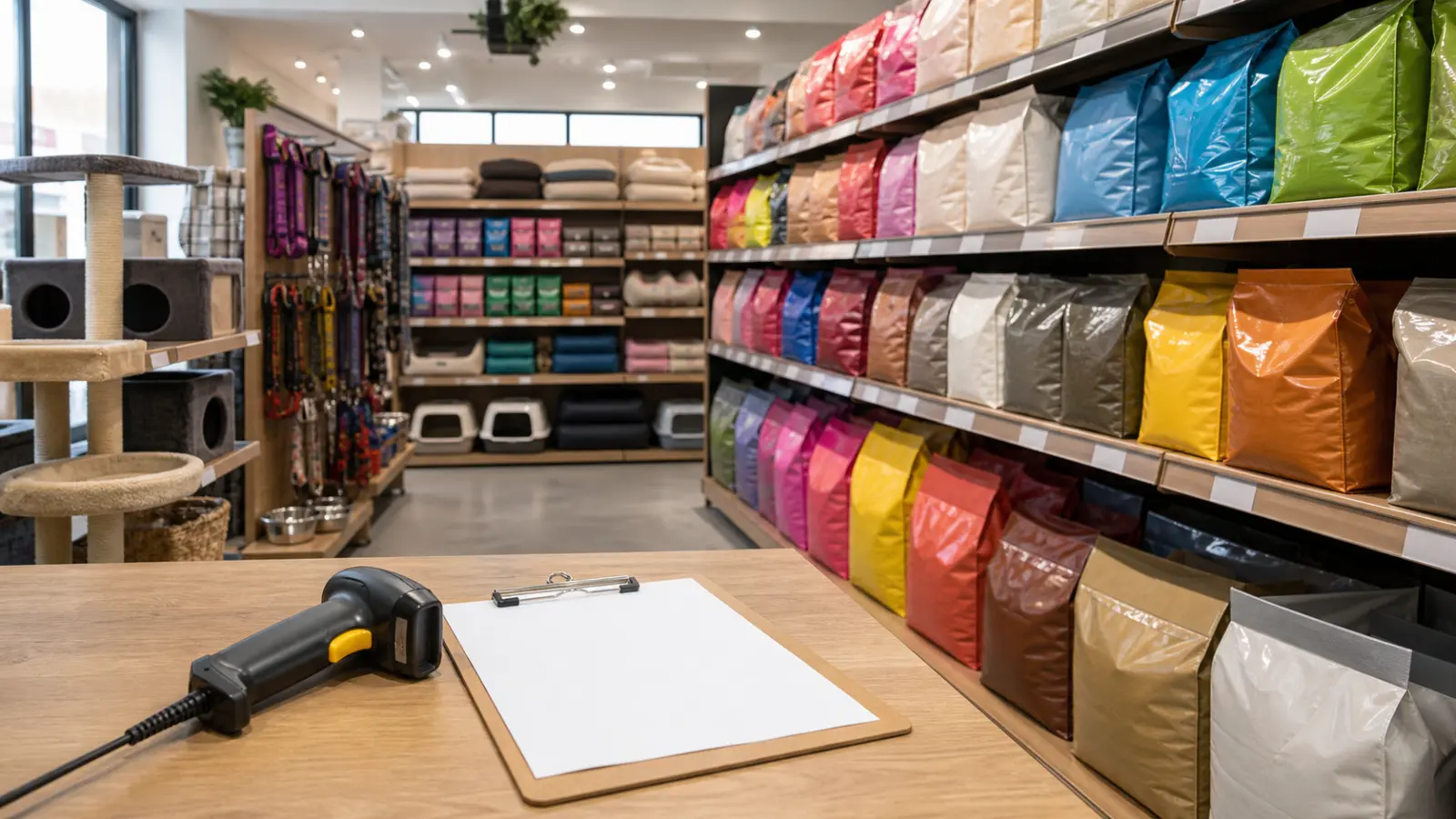

A pet shop's profitability doesn't depend on sales volume alone. Products sitting on the shelf, pet food nearing its expiration date, capital split across too many varieties and staples that keep running out all hit your cash flow at the same time. That's why an inventory plan should aim to give the right depth to the right product group, not simply fill the store with products.
The guide to opening a pet shop gives a general framework for the setup process. Here we'll look at how food, accessories and live animals behave differently as stock. Every store has its own customer profile, location and sales channel. So instead of promises of earnings or one-size-fits-all order quantities, you need decision rules you can measure.
Read stock turnover by product group
Stock turnover tells you how much of the product on hand was sold and replenished over a given period. A single store-wide average can be misleading: pet food that customers buy regularly and a carrier that may sit for months shouldn't be judged on the same scale. Keep records of stock in and out at the level of category, subcategory, brand, package size and, if possible, product code.
A fast-moving product doesn't always leave a high contribution, and a slow-moving one may bring in more per sale. So read turnover together with gross contribution, shelf space used, lead time and spoilage risk. The goal isn't just to stock more of the fastest seller, but to use the store's cash and shelves in a balanced way.
Set up a basic measurement table
For each product, create fields for opening stock, purchases during the period, sales, returns, losses and closing stock. Add lead time and minimum order quantity next to them. If there's a gap between your regular counts and the system records, solve the cause of that gap first. A profitability analysis built on faulty stock data produces order decisions that look right but are wrong.
Balance continuity and shelf life in pet food stock
Pet food is a category where customers have a strong tendency to buy again. When a particular product runs out, it can affect not just that day's sale but the customer's habit as well. On the other hand, keeping more large package sizes and variety combinations than you need creates pressure from expiration dates and storage. Identify the core products that are in frequent demand and set a higher availability target for them.
Set up a system that puts products forward by how soon they need to be sold, not the order they arrived in the storeroom. At delivery, check package integrity, dates and batch information. Don't let short-dated products get mixed in with regular stock unnoticed. When ordering, look not only at last month's sales but also at the date by which the stock on hand can be sold.
Manage each package size as a separate product
The small and large bags of the same food meet different customer needs. One selling fast doesn't mean the other will turn over at the same rate. Track sales frequency by package size, and set separate reorder points for small bags bought as a trial and large bags used regularly. Too many options create the appearance of variety while thinning out the capital tied to each one.
Choose between breadth and depth in accessories
Collars, beds, toys, carriers and grooming accessories are usually bought again less often than pet food. Variety in color, size and model quickly multiplies the number of stock codes. Instead of holding many units of every variant, strike a balance between enough breadth to show customers options and stock depth in the variants that actually sell.
Don't judge shelf space by unit count alone. A bulky bed may take up more space and handling effort than a small accessory, even if both reach the same number of sales. Look at category performance together with contribution per shelf space and time spent in stock. Don't automatically carry variants that haven't moved for a long time back onto the reorder list.
Treat live animals as a separate operation
Selling live animals brings responsibilities and processes that differ from packaged product stock. Housing, daily care, registration, suitable conditions, authorized suppliers and the relevant legal requirements must be verified before the business opens. Approaching this category only through its sales potential overlooks both the operation and animal welfare. Don't make a decision without confirming the current local and national requirements with the relevant authorities.
Live animals have ongoing needs such as feed, space, equipment, cleaning and staff time. So judging them only by the difference between purchase and sale price is incomplete. When demand slows, the care load continues. If the business lacks the right infrastructure and expertise, not opening the category is also a valid stock decision.
Turn seasonal demand into an ordering calendar
Carriers during travel seasons, some walking accessories when people spend more time outdoors, or certain care products when the weather changes may see different demand. But don't assume that last season's movement will repeat the same way. Pull sales dates by category and see when the increase started and how long it lasted.
Managing seasonal products with staged purchases that match lead times, rather than one big order, can reduce risk. Watch demand with a small first batch at the start of the season, and if the sales pace is confirmed, place a follow-up order. If lead times are very long, you may need to decide earlier, but in that case write down the leftover-stock scenario in advance too.
Flag dead stock risk early
A product that hasn't sold at all for a certain period, whose season has passed, whose packaging is getting old or whose demand has dropped because a new model arrived can turn into dead stock. Instead of discovering the problem at the year-end count, use an aging report. Group products by last sale date and time since arrival in the storeroom. Set up a workflow where items go to the responsible person for review as their waiting time grows.
Not every slow product has to be sold off at a loss right away. First check causes such as the product page, shelf visibility, the wrong category, missing size information or staff not knowing the product. If a lack of demand is confirmed, consider stopping reorders, returning it if supplier terms allow, a controlled promotion or moving it to a different sales channel. Make the decision within the limits of the expiration date and the law.
Calculate profitability with real costs before discounting
The difference between a product's purchase and sale price isn't profit on its own. Shipping, payment processing, packaging, losses, returns, shelf space and the operational time spent handling the product also affect category decisions. Allocating every item down to the product level can be hard; at the very least, build a regular contribution table by category.
A discount can get slow stock moving, but if it's repeated without solving the underlying cause, customers may put off buying until the next sale. Before a promotion, make the goal clear: is it to free up space, to clear out short-dated products in a controlled way, or to introduce a new category? After the promotion, measure not only units sold but also remaining stock and the change in contribution.
Tie the reorder point to lead time
The reorder point should kick in not when the product is completely gone, but when enough stock remains to last until the delivery arrives. To set it, you look at average sales rhythm, delivery time, delivery reliability and unexpected shifts in demand together. For very fast-moving staples a small safety stock can make sense; for slow products the same approach can tie up capital you don't need to.
Stock and product tracking can make it easier to follow product arrivals, sales and low-stock alerts in one place. Still, don't approve automatic suggestions blindly. Add context such as the end of a season, price changes, new product arrivals and supplier terms to your ordering decision.
Hold regular category meetings
In a short weekly check, go over core products that ran out, approaching dates and delivery delays. In a monthly check, compare turnover, contribution, stock age and shelf space by category. In a less frequent, more thorough review, look at variants customers no longer respond to and at new trial products.
Writing down decisions matters. If you know why a product was increased, why it was dropped from orders or on what assumption it was bought for the season, you can evaluate the result in the next period. Without records, the team may repeat the same experiment and the source of a failure stays hidden.
Frequently Asked Questions
Which product group turns over faster in a pet shop?
It depends on the store's customer profile. Pet food that's consumed regularly usually creates repeat buying behavior, while accessories may turn over less often. You need to base the decision on sales records at the category and product code level, not on assumptions.
How many kinds of pet food should you carry?
Instead of a fixed number, identify the products that meet core demand. As brands, formulas and package sizes multiply, the stock tied to each variant grows too. It's more controlled to keep availability steady for regular sellers and test new varieties with small trial orders.
When do you notice dead stock?
You notice it early if you regularly track last sale date and time in stock. The threshold may vary by category; what matters is having a clear rule that stops the product from being reordered and sends it for review by the person responsible.
Does inventory software increase profitability automatically?
No. Software makes collecting data and generating alerts easier. Profitability is managed through choosing the right products, seeing real costs, reliable counts and regularly turning records into decisions.