
When a rabbit comes home, one of the first decisions is usually about living space: should it stay in a cage, or roam freely around the house? The standard cages sold in pet stores look like a practical solution at first glance. The trouble is that most of them are far too small for a rabbit to spend its days, and its life, inside. If you are thinking about adopting a rabbit or have just adopted one, getting this right from the start will give both you and your rabbit years of benefit.
Contrary to popular belief, rabbits are not rodents. They belong to the lagomorph family, and in nature they run across wide areas, make sudden leaps and dig tunnels. For them, movement is not a luxury but a basic requirement for both physical and mental health. Years spent in a cramped space can lead to a picture that includes weight gain, muscle loss, spinal problems, sore feet and withdrawal.
In this article, we walk step by step through a rabbit's real space needs, how to make your home safe for free roaming, whether litter training is possible, how to choose flooring and toys, and the cage+pen hybrid setup that is the ideal solution for most homes.
A Rabbit's Real Space Needs: Why Is a Cage Usually Not Enough?
There are three simple measures for a rabbit to be comfortable: when it stands fully upright on its hind legs, its ears should not touch the ceiling; it should be able to stretch out at full length; and it should have room to make at least three or four hops in a row. Most standard pet shop cages meet none of these. A rabbit that can barely turn around inside is, in fact, constantly restricted.
The situation is no different for small breeds. For example, the Holland Lop, known for its cute floppy ears, is a dwarf breed, yet its energy and need to run and jump are no less than those of larger breeds. In other words, a small rabbit does not mean a small space.
This does not mean you have to throw the cage away entirely. The cage can still work perfectly well as a home base with its door open, where the food bowl, water bottle and litter box are kept. The real problem is a rabbit spending most of its day locked up.
Free Roaming: Freedom Is Great, but Is Your Home Ready?
In a free-roaming setup, the rabbit wanders as it likes through the whole home or through rooms you choose. When it is set up correctly, this is the richest way of life for a rabbit: more movement, more exploring, a stronger bond with you. But there is a serious difference between simply opening the door and safe free roaming. Do not take this step before you have scanned your home through a rabbit's eyes.
Cables: The Biggest Hazard
A rabbit's urge to chew cables is almost a reflex; anything thin, flexible and root-like is a target to be chewed. Electric shocks and mouth burns are among the most common serious accidents in free-roaming rabbits. Lift chargers, headphones and extension cords off the floor, and cover the ones you cannot move with spiral cable protectors or hard cable channels. Do not forget the hidden cables behind furniture either; rabbits love squeezing into narrow gaps.
Toxic Plants and Other Risks
Dieffenbachia, lilies, ivy species and many popular houseplants are toxic to rabbits. Move pots to a height the rabbit cannot reach, and pick up fallen leaves right away. Other things to watch out for:
- Balconies and windows: An open balcony door or a window without a railing carries a fall risk; mesh or a safety net is a must.
- Chemicals: Cleaning products, rat poison and insecticides should be kept in a closed cabinet.
- Small objects: Rubber bands, plastic pieces and rug fringes can cause an intestinal blockage if swallowed.
- Gaps between furniture: Block off spots where a rabbit could get stuck, such as under the sofa or behind appliances, with cardboard or panels.
If you think your rabbit ate something suspicious, do not wait; contact your vet without losing time.
Is Litter Training Possible?
Yes, and it is easier than most people think. Rabbits naturally prefer to go in certain corners, and with the right setup this instinct turns into a reliable litter habit within a few weeks. Spaying or neutering makes the process noticeably easier because it reduces territorial marking.
- Watch which corner your rabbit uses on its own and place the litter box right there.
- Line the box with a paper-based, dust-free bedding; cat litter and pine shavings are not suitable.
- Put a handful of hay on top of the bedding. Rabbits like to go while they eat, so moving the hay closer speeds up training.
- Move any droppings outside the box into it, so the smell points to the right spot.
Small accidents are normal, especially in the first months. Punishment never works; patience and consistency are enough.
Choosing Flooring: Slippery Floors Are a Rabbit's Enemy
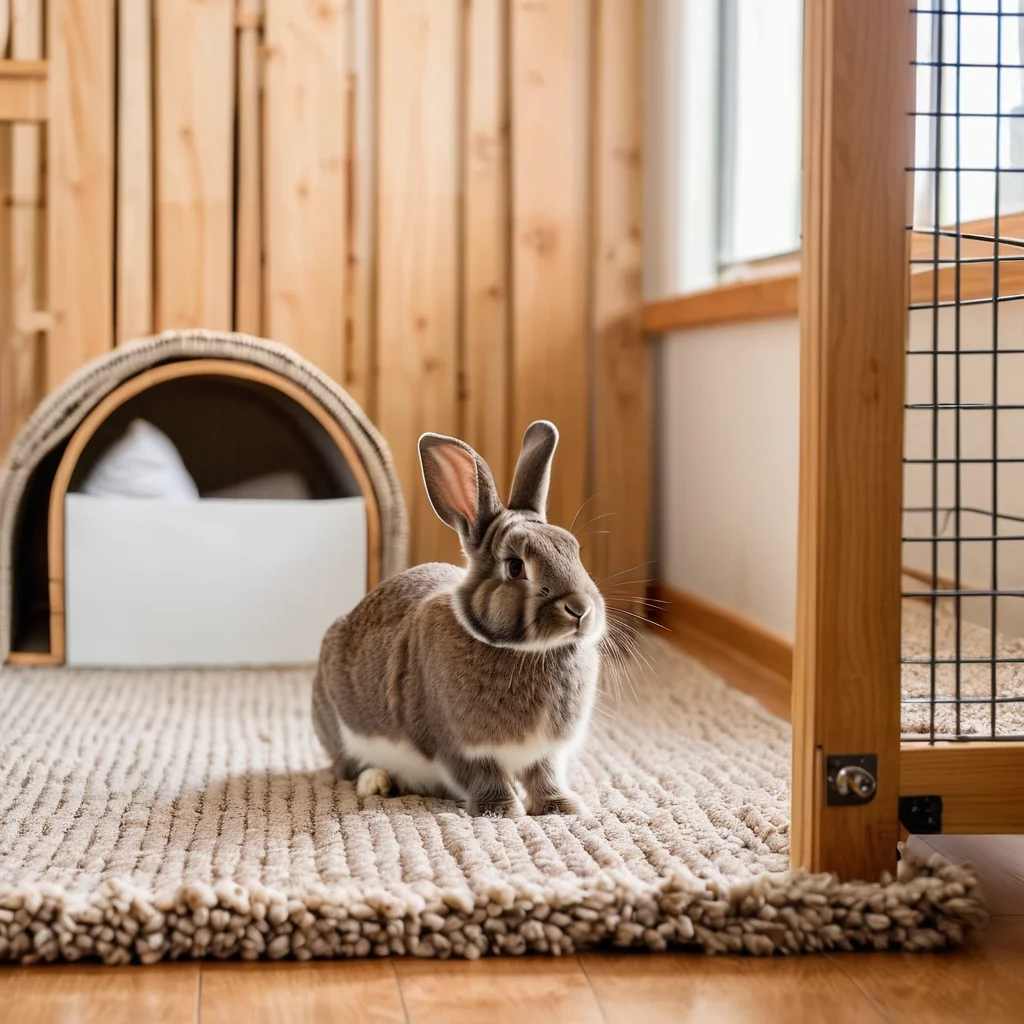
Slippery floors such as hardwood, laminate and tile are both stressful and risky for rabbits. Rabbit feet do not have pads like those of cats and dogs; they are covered in fur and cannot grip a slippery surface. A rabbit that keeps slipping stops running and also faces a risk of hip and spine injury.
The solution is simple: lay washable mats, carpet tiles or low-pile rugs along the paths your rabbit uses. When choosing a rug, avoid looped and fringed styles, since loose threads can be swallowed. If the cage or pen has a wire floor, always cover it with a flat surface; wire floors are a classic cause of sore feet.
The Need to Chew and Toys
Rabbit teeth grow for life, so chewing is not a pleasure for them but a requirement for dental health. If there are no proper things to chew in their space, rabbits chew the wrong things: baseboards, sofa edges, book spines. So the way to protect your furniture is not to forbid chewing but to offer alternatives.
- Untreated apple and willow branches: A classic, safe option for wearing down teeth.
- Cardboard boxes and tunnels: Meet both the need to chew and the need to hide; make sure there is no tape or labels.
- Hay balls and woven hay toys: Combine play with feeding.
- Dig box: A box filled with shredded paper safely satisfies the instinct to dig tunnels.
If you rotate toys weekly, curiosity stays fresh and interest in the furniture drops.
The Happy Medium: A Cage and Pen Hybrid Setup
For most homes, the most balanced solution is a hybrid setup between a full-time cage and full freedom. In this setup, the cage becomes the home base, and a large pen made of metal fence panels is set up around it. The cage door stays open to the pen; the rabbit goes into the cage for food, water and the litter box and spends the rest of its time in the pen. When you are home and can keep an eye on things, the pen gate is opened too, and the rabbit roams freely in a room that has been made safe.
The advantages of this setup are very clear: the rabbit stays safe at night or while you are away, litter training goes faster because it runs from a single center, and since the move to free roaming is gradual, the risk of household accidents goes down. Over time, once your rabbit is fully used to the home, you can remove the pen and switch to full free roaming.
Whichever breed you adopt, the basic needs are the same, but breeds differ in size, coat care and temperament. Before adopting, you can browse our rabbit breeds guide to find a breed that suits your living space.
Frequently Asked Questions
Can a rabbit live in a cage all the time?
It will survive, but it cannot live a healthy life. Weight gain, muscle weakness, sore feet and behavior problems are common in rabbits kept locked up all day. At most, the cage should be a home base; a rabbit should be able to move around outside the cage for hours every day.
How long does litter training take?
With the right setup, most rabbits start using the litter box regularly within a few weeks. In spayed or neutered rabbits, the process is noticeably faster and more lasting. Temporary accidents during adolescence are normal, so keep going patiently.
Is it a problem to keep the rabbit in the pen at night?
No, in fact it is recommended for safety. Rabbits are active at dawn and dusk; if your rabbit has moved around freely enough during the day and evening, spending the night in a large pen with hay, water and a litter box is perfectly healthy.
Is an apartment enough for a rabbit?
Yes. Rabbits do not need a yard; what matters more than square footage is offering a safe, non-slippery space where they can move freely every day. A living room with cable protection and plant control is a perfectly adequate world for most rabbits.