
Puppy Training: The First 30 Days Plan
Bringing a new puppy home is exciting, but the first 30 days are a critical time for both you and your puppy. The steps you take now lay the foundation for a relationship that will last for years. With the right training approach, your puppy grows into a confident, well-mannered and happy adult dog. In this in-depth guide, you will find a week-by-week breakdown of what to do in the first 30 days.
Getting Ready Before Training
Prepare Your Home
Before you bring your puppy home, you need to make your space safe:
- Remove hazards: Move electrical cords, small objects, toxic plants and cleaning products out of your puppy's reach
- Set off-limits areas: Decide ahead of time which rooms your puppy can enter and which furniture they can get on
- Get the basic supplies: Food bowl, water bowl, collar, harness, toys, crate (if needed), potty pads, cleaning supplies
- Book a vet appointment: Have your puppy checked by a vet within the first 48 hours after coming home
Set Family Rules
Everyone in the family should follow the same rules. For example, if the puppy is not allowed on the bed, nobody should let them up there. Inconsistency confuses your puppy and slows down training.
Week 1: Settling In and Building Trust
Days 1-2: A Calm Start
The first days can be very stressful for your puppy. They have just been separated from their mother and littermates and are in a completely new environment. During this time:
- Provide a calm, quiet environment. Avoid getting overly excited or inviting lots of visitors
- Create a safe space for your puppy: set up their own corner with a crate, cushion or blanket
- Let them explore one part of the house, but don't open up the whole house right away
- Crying on the first night is normal. You can mimic their mother's warmth by placing a ticking clock or a warm water bottle next to them
Days 3-4: Start Building a Routine
Dogs love routine, and a predictable schedule helps them relax:
- Mealtimes: 3-4 meals a day (for puppies 2-4 months old), at the same times every day
- Potty breaks: Take them outside after meals, after waking up, after play and every 1-2 hours
- Sleep schedule: Puppies can sleep 18-20 hours a day, and that is normal
Days 5-7: Introduction to Crate Training
Crate training is misunderstood by many people, but when done correctly, it gives your puppy the feeling of a safe den:
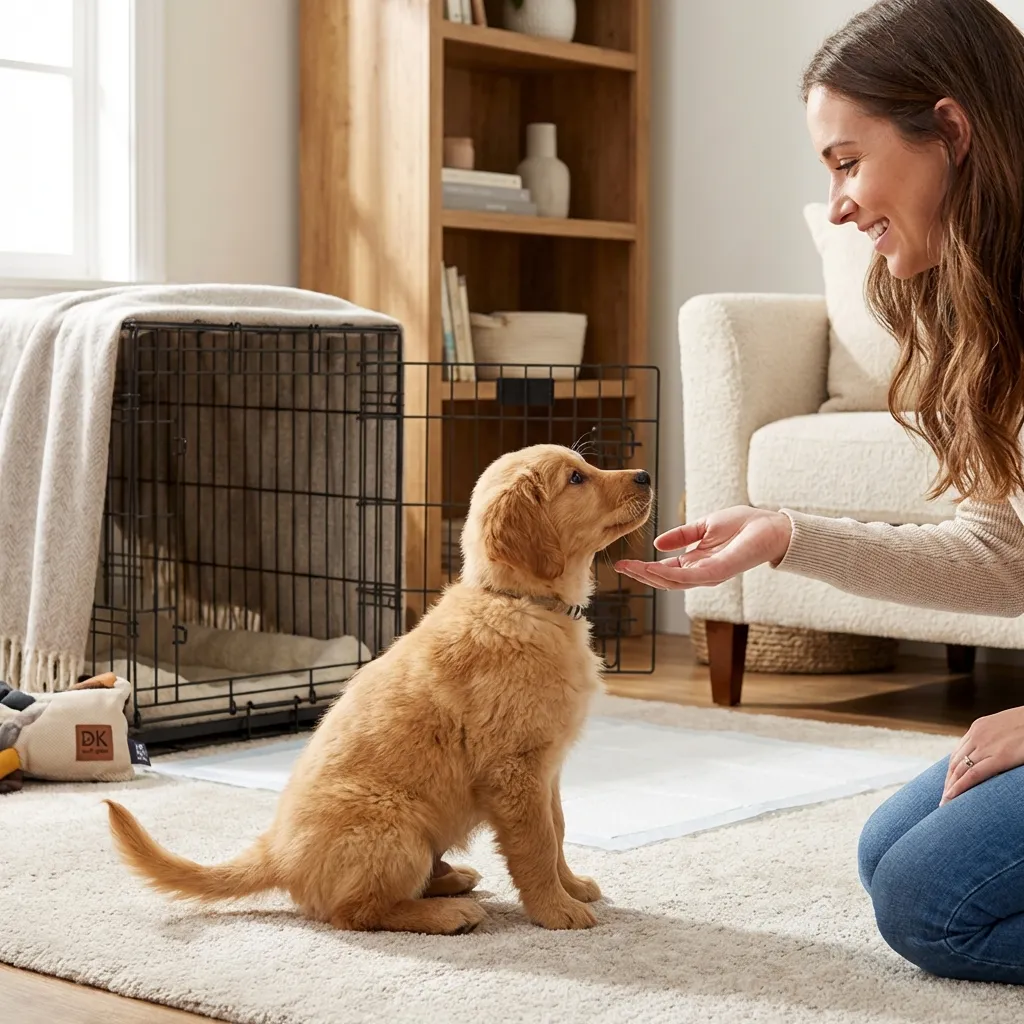
- Leave the crate in the living room with the door open
- Put a blanket, a toy and a little food inside
- When your puppy goes in on their own, praise and reward them
- Don't close the door for the first few days
- Gradually increase the time the door stays closed (start with just 1-2 minutes)
- Never use the crate as a punishment
- Letting your puppy out while they are crying teaches them that crying works; wait for them to calm down
Week 2: Potty Training and Name Recognition
Potty Training Basics
Potty training is one of the most important kinds of training, and it takes patience. Puppies aged 8-16 weeks can't hold their bladder for long yet.
Golden Rule: Always take your puppy outside in these situations:
- Right after waking up
- 15-30 minutes after eating
- After drinking water
- During or after play
- After coming out of the crate
- At least every 2 hours
When they go potty outside: Praise them enthusiastically right away and give a treat. Praise them in an excited tone, like "Good job! Good dog!" Timing is critical: the reward should come the moment they finish.
When they have an accident indoors: If you didn't see it happen, don't punish them. Clean it up and move on. Punishment makes your puppy afraid of you and leads them to go potty in hidden spots. If you catch them in the act, calmly take them outside.
Cleaning tip: Clean accident spots with an enzymatic cleaner. Regular cleaning products can't fully remove the smell, and your puppy may go in the same spot again.
Name Recognition Training
Teaching your puppy their name is the foundation for all other training:
- Say their name in a calm setting
- Reward them as soon as they look at you
- Repeat this 10-15 times a day
- Practice in different rooms and settings
- Never use their name in a negative context (don't link it with scolding or punishment)
Week 3: Basic Commands and Socialization
The "Sit" Command
This is the most basic command and the easiest one to teach:
- Hold a treat in your hand and bring it close to your puppy's nose
- Slowly move the treat back over their head
- As their head follows it, they will naturally sit
- The moment they sit, say "Sit" and reward them right away
- Do 3-5 sessions a day, with 5 repetitions per session
The "Come" Command
This is the most critical command for safety:
- Start from a short distance (1-2 meters)
- Say their name, then say "Come!"
- When they come, give a big reward and enthusiastic praise
- Never do anything unpleasant after saying "Come"
- Gradually increase the distance
Socialization: The Critical Period
The period between 3 and 16 weeks is the most critical time for a puppy's socialization. The experiences they have during this window largely shape how they behave as adults.
What to introduce your puppy to:
- Different people: Kids, older people, people wearing hats or glasses, people of different genders
- Different sounds: Traffic, the vacuum cleaner, the washing machine, thunder (you can start with recordings at low volume)
- Different surfaces: Grass, asphalt, sand, metal grates, stairs
- Other animals: Controlled introductions to vaccinated, healthy dogs (don't go to a dog park until they are fully vaccinated)
- Different environments: Car rides, city sounds, crowded places (carrying them in your arms)
Important: Socialization experiences should always be positive. Don't put your puppy in situations that frighten them. Pair every new experience with rewards and positive reinforcement.
Week 4: Leash Training and More Commands
Getting Used to the Collar and Harness
- Days 22-23: Have your puppy wear the harness at home for short periods (5-10 minutes). Give treats while putting it on. If they get uncomfortable and try to take it off, distract them with a toy.
- Days 24-25: Let them walk around the house wearing the harness. Without attaching the leash, help them get used to the harness.
- Days 26-27: Attach the leash and encourage them to walk after you inside the house. Don't pull; reward them for walking beside you.
- Days 28-30: Start short outdoor walks (5-10 minutes). Choose a quiet, calm route.
The pulling problem: If your puppy pulls, stop and stand still. When the leash goes slack, continue the walk. Reward them when they walk beside you. This takes patience, but building the right habit from the start is much easier.
The "Stay" Command
- Put your puppy in the "Sit" position
- Hold your open hand out toward them and say "Stay"
- Wait 1-2 seconds and reward them right away
- Gradually increase the time (add 2-3 seconds each session)
- As the time increases, gradually increase the distance too
Bite Inhibition
Puppies want to bite during play; this is natural behavior. Still, teaching bite inhibition is a must:
- When your puppy bites your hand hard, say "Ouch!" in a high-pitched voice and stop playing immediately
- Give them no attention for 10-15 seconds and ignore your puppy
- Start playing again; allow gentle mouthing, and stop again when they bite hard
- Gradually lower the level of bite pressure you accept
- Encourage them to chew on toys instead of your hand
- Never use physical punishment; methods like holding their mouth shut or tapping their nose destroy trust
Sample Daily Routine (Week 4)
- 07:00 - Wake up, go outside (potty), short walk
- 07:30 - Breakfast (puppy food)
- 07:45 - Go outside (potty)
- 08:00 - Short training session (5 minutes: sit, come)
- 08:15 - Free play time
- 09:00 - Nap / rest
- 11:00 - Wake up, go outside, short play
- 12:00 - Lunch
- 12:15 - Go outside
- 12:30 - Training session (5 minutes)
- 13:00 - Nap / rest
- 15:00 - Wake up, go outside, socialization activity
- 17:00 - Dinner
- 17:15 - Go outside
- 17:30 - Training session (5 minutes)
- 18:00 - Family time
- 20:00 - Last trip outside
- 20:30 - Late-night meal (optional, based on your vet's advice)
- 21:00 - Bedtime
Common Mistakes to Avoid
- Punishment and fear: Physical punishment, yelling or scaring your puppy keeps them from trusting you and leads to behavior problems
- Inconsistency: Rules should be the same for everyone, all the time. An "allowed today, forbidden tomorrow" approach doesn't work
- Expecting too much: Expecting perfect behavior from an 8-12 week old puppy isn't realistic. Patience and repetition are key
- Too little socialization: Once the critical period passes, socialization becomes much harder. Even while you wait for the vaccination schedule, carry your puppy in your arms to different places
- Long training sessions: A puppy's attention span is 5-10 minutes. Long sessions lead to boredom and a lack of interest in learning
- Starting late: The "we'll teach them when they're older" approach is a big mistake. The first months are when their capacity to learn is highest
- Leaving them alone: Leaving a puppy alone for hours sets the stage for separation anxiety. Increase their alone time gradually
When Should I Get Professional Help?
It is a good idea to consult a professional dog trainer in these situations:
- Excessive aggression or fearful behavior
- No progress in potty training for more than 4 weeks
- Your puppy shows excessive biting behavior
- Signs of severe separation anxiety
- Not eating or extreme fear reactions
Puppy Classes
Puppy classes for puppies aged 8-16 weeks are a wonderful opportunity for both basic training and socialization. In these classes, your puppy meets other puppies in a controlled setting and learns basic commands, and you get professional guidance. You can ask vet clinics and dog training centers in your city about puppy class programs.
What to Expect After 30 Days
By the end of the first 30 days, you can expect your puppy to:
- Respond to their name
- Do the basic "Sit" and "Come" commands (at least at home)
- Make real progress with potty training (accidents can still happen, and that's normal)
- Feel comfortable in their crate
- Be used to the harness and leash
- Show progress with bite inhibition
- Have met a variety of people and sounds
Every puppy learns at a different pace; some move faster and some move slower. What matters is staying consistent and patient, celebrating every small success and making the process enjoyable.
Remember, puppy training is a marathon, not a sprint. The first 30 days are just the beginning; training is a process that continues throughout your puppy's life. But the solid foundation you build now sets you up for many happy years together.